For decades, Alzheimer’s researchers have pursued a critical goal: identifying the specific biological changes that drive the disease.
This work has led to transformational discoveries. Scientists identified amyloid plaques and tau tangles as hallmarks of Alzheimer’s disease, uncovered genetic risk factors, and developed the first treatments capable of slowing cognitive decline for some people.
But no single protein explains the disease. Scientists are now studying Alzheimer’s as a breakdown of the connected systems of the brain rather than a failure of any one part in isolation.
BrightFocus Foundation’s Alzheimer’s Disease Research program has long championed this idea by taking a 360-degree approach to funding that backs innovative ideas across a wide range of scientific paths.
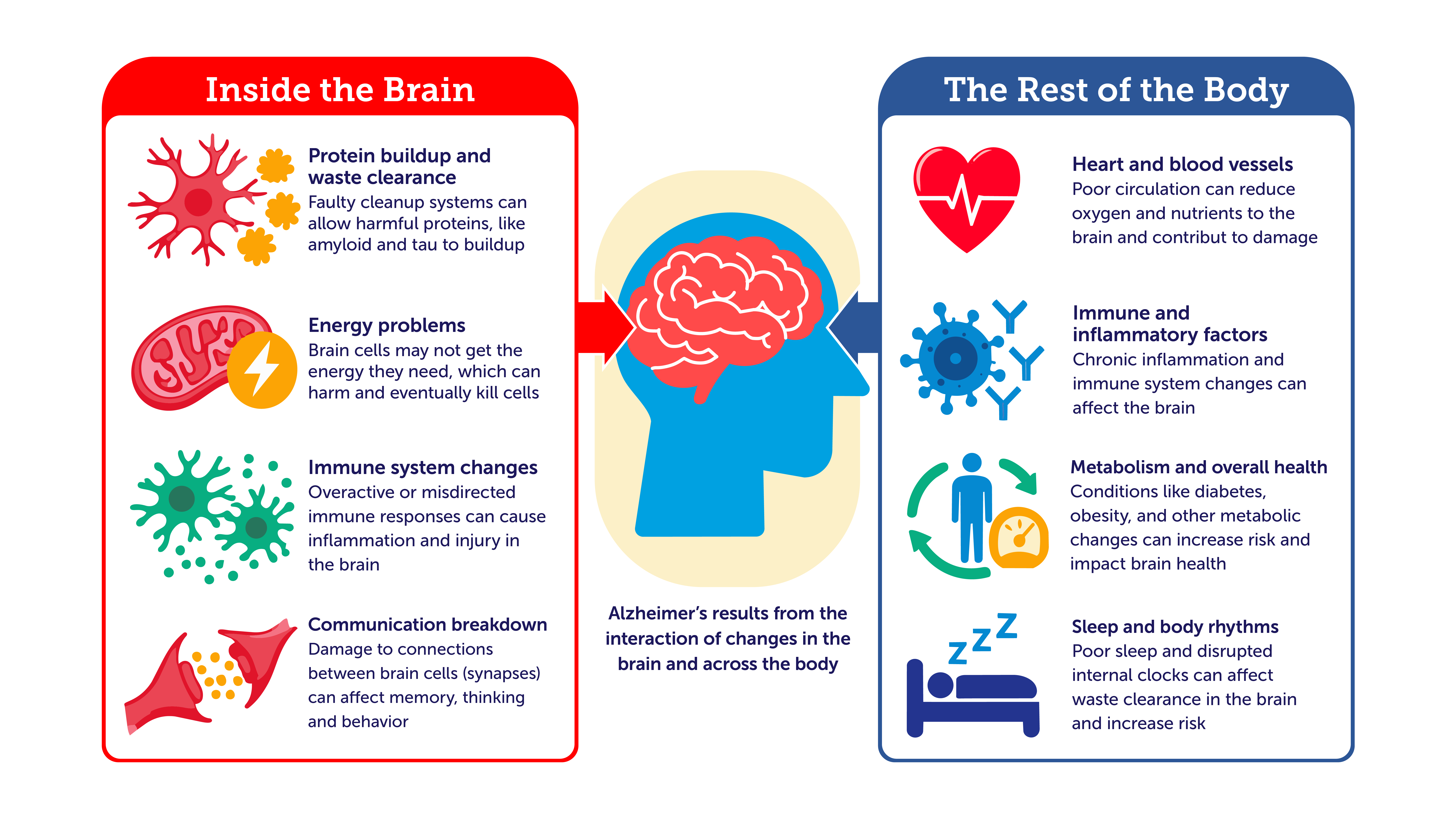
Think of the brain as a city fed and powered internally and by the vast network of cardiovascular, immune, and other systems of the body. To function properly, it depends on a cleanup crew, a power grid, first responders, and sound wiring, and each of these relies on the others. When one falters, the rest strain and, in the case of the brain, eventually memory, thinking, and behavior are affected.
A better understanding of how these systems work together to support brain health is key to unraveling the persisting mysteries of Alzheimer’s. Alzheimer’s Disease Research has identified several areas shaping the next phase of innovative science. Once considered secondary, these concepts are now thought of as central to understanding brain aging and neurodegenerative disease.
Explore a few of these key research areas we’re investing in that are shaping the future of the field, all thanks to our generous community of donors who make this work possible.
What makes some people resilient to Alzheimer’s disease?
One of the most interesting emerging questions isn’t about what causes Alzheimer’s, but rather, what protects some people from ever developing it.
Henne Holstege, PhD, studies people who keep their memory and cognitive skills well past the age of 100. Her work, funded by Alzheimer’s Disease Research, suggests that some people carry rare genetic and biological traits that help their brains withstand changes like the formation of amyloid and tau, the proteins that build up in Alzheimer’s.
This phenomenon is called “resilience,” and scientists like Dr. Holstege who study it turn the usual question about Alzheimer’s around: what goes right during healthy brain aging?
Resilience is also uncovering another larger truth: Alzheimer’s disease does not look the same in everyone. Studies in diverse populations have shown that the biological signs of Alzheimer’s vary across people and communities. That suggests that there is more than one route to cognitive decline.
It is why scientists hope to move past one-size-fits-all treatments toward strategies that target the disease from several angles. It’s also why a whole-body approach to understanding how Alzheimer’s develops is crucial to our understanding of what goes wrong and what we can do to fix it.
The cleanup crew: how the brain clears waste
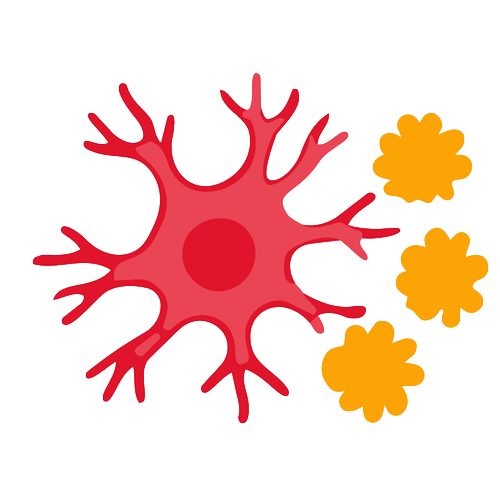 Every cell in the body, including the brain, has a maintenance system that makes proteins, folds them into the correct shape, and recycles or removes those that no longer work properly. Scientists call this process proteostasis, and, when it works, the brain stays healthy and resilient.
Over time with age, this system becomes less efficient. Alzheimer’s Disease Research funds studies on how breakdowns in protein cleanup, energy use, and immune function may contribute to the earliest stages of the disease.
One challenge facing researchers is mimicking sporadic (i.e., occurring at random rather than due to genetics) Alzheimer’s. Research from Ching-Chieh Chou, PhD, is recreating this form of the disease by turning donor tissue into human neurons that can be grown and studied in the lab and has found that defects in proteostasis are an early driver of the disease.
The effects may reach well beyond individual cells. Christopher Morrone, PhD, has linked faulty waste clearance to the sleep problems that appear early in Alzheimer’s.
The body’s internal clock matters too. Research from Ashish Sharma, PhD, suggests that disrupting it, as with chronic jet lag or shift work, can impair waste clearance and could add to amyloid buildup in the brain.
Together, these findings suggest that problems in the brain’s cleanup system start disrupting how cells work long before many of those cells die. That gap could be a window for earlier detection and treatment.
The power grid: how brain cells use energy
 Neurons need a steady supply of energy, in part to maintain the proteins that keep them running. When that energy supply begins to fail, damaged proteins can pile up, feeding a cycle that further slows the brain’s processing speed and cognition.
Shannon Macauley, PhD, has shown that Alzheimer’s disrupts how brain cells use energy. Her Alzheimer’s Disease Research-funded work suggests that the buildup of amyloid and tau changes the way the brain processes fuel, affects brain cells’ ability to switch fuel sources as needed, and increases inflammation. It could also contribute to problems with sleep and brain activity. If so, restoring the brain’s energy balance could become a new way to treat Alzheimer’s.
Neurons aren’t the only cells affected by energy problems. Glial cells, which nourish, protect, and clean up after neurons, share fuels and resources to maintain energy balance. During aging and disease, resource-sharing becomes inflexible, and processing nutrients and removing waste becomes more difficult. That added stress may contribute to the effects of Alzheimer’s.
The first responders: the brain’s immune system
 For years, Alzheimer’s was seen mainly as a disease of brain cells. Scientists now know that trouble inside the brain can trigger immune responses throughout the body. Those responses might shape how the disease develops and progresses.
Alzheimer’s Disease Research grantee David Gate, PhD, helped show that immune cells circulating in the blood respond to signals from the Alzheimer’s brain. More recently, researchers found specialized areas around the brain where immune cells and brain cells can communicate.
Inside the brain, immune cells called microglia are the first line of defense. They clear debris, support healthy neurons, and respond to injury. In Alzheimer’s, microglia can stop working properly and become less effective at protecting the brain.
Genes also play an important role. Two of the most important Alzheimer’s risk genes, TREM2 and APOE, help determine how immune cells respond to damage and disease. Tom Brett, PhD, and other investigators have shown that TREM2 works as a sensor that helps immune cells detect damage and cellular stress.
Discoveries like these point toward potential new treatments aimed at restoring the brain’s natural defenses and slowing disease progression.
The wiring: the cells that support neurons
 Healthy brain function depends on more than just neurons, and glial cells are increasingly seen as being central to brain health.
Among the most important are oligodendrocytes. These cells make myelin, the protective coating that acts much like insulation on a wire to help neurons communicate efficiently. Emerging research suggests that changes in myelin, and in the oligodendrocytes that make it, are a key feature of both normal brain aging and Alzheimer’s.
Alzheimer’s Disease Research-funded work is also showing that genes are again a key component as well. APOE is one of the strongest genetic risk factors for Alzheimer’s, yet one version of the gene, APOE2, is protective against developing the disease. Research led by Na Zhao, MD, PhD, suggests that the protection offered by APOE2 may be tied to healthier myelin maintenance, raising intriguing possibilities for new prevention and treatment strategies.
This area of research could also explain why certain approaches may benefit brain health. Sensory stimulation, ultrasound, and hormone-related therapies, all being actively studied, could help preserve myelin and the network of cells that keep neurons working properly. These findings are revealing new opportunities to preserve cognitive function as we age.
Building toward the next breakthrough
Every major advance in Alzheimer’s research began with a question no one had asked before.
The centenarians who keep their memory are a clue to what maintains brain function regardless of age. Amyloid, tau, and genetics have transformed what scientists know about Alzheimer’s. Looking ahead, researchers are starting to consider more holistically how bidirectional brain-body systems work together and what happens when they start to break down.
Alzheimer’s Disease Research is following that question further: looking at women’s health and sex-based differences in the disease; how Alzheimer’s interacts with other diseases; how lifetime exposure to pollutants, lifestyle, infection, stress, and social factors impact disease risk; and the links between the brain and the rest of the body.
As researchers continue connecting the dots between cellular health, brain function, and resilience, they move closer to a future where Alzheimer’s disease is detected earlier, treated more effectively, and ultimately prevented.
You can make a meaningful impact in the fight against Alzheimer’s disease. Learn how to support this important work and advance critical research toward a cure.
Adapted from: Rossi, S.L., Bovenkamp, D.E. Advancing a systems-level understanding of neurodegeneration: the BrightFocus Alzheimer’s disease research portfolio. Mol Neurodegeneration 21, 50 (2026). https://doi.org/10.1186/s13024-026-00984-8