Transcript
Download PDF
Please note: This Chat has been edited for clarity and brevity.
MS. SARAH DISANDRO: Hello, and welcome. My name is Sarah DiSandro, and on behalf of BrightFocus Foundation, I’m pleased to be your host for today’s Macular Chat, “Fire Safety for People With Low Vision.” Macular Chats are a monthly program—supported in part by sponsorship from Genentech, Regeneron, and Merck—designed to provide people living with macular degeneration and the family and friends who support them with information straight from the experts. BrightFocus Foundation’s Macular Degeneration Research program has supported more than $61 million in scientific grants exploring the root causes and potential prevention strategies and treatments to end this sight-stealing disease.
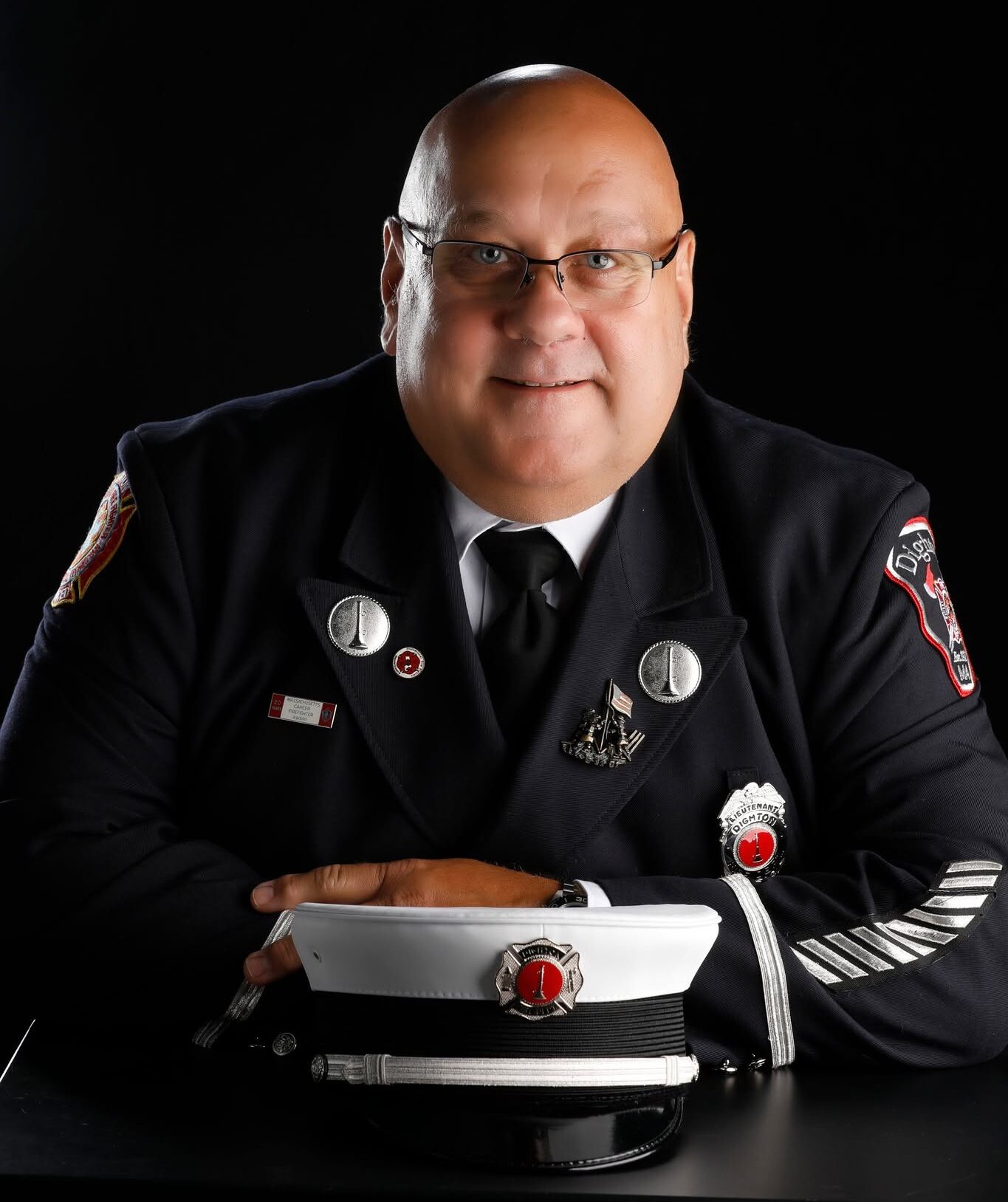
I would like to now introduce today’s guest speaker, Lieutenant Thomas Medeiros. Lieutenant Thomas Medeiros was a firefighter, NRAEMT—that’s a nationally registered advanced EMT—for the town of Dighton, Massachusetts. In his 32 years of service, he held many certifications, was president of the union, president of the fire association, and the director of the Dighton Junior Firefighter Program, a youth organization that taught basic firefighting and first aid skills to young men and women from all over the state who were interested in a fire or an EMS career. In May 2021, he was diagnosed with wet macular degeneration, which ultimately ended his career as a firefighter. For years, he taught fire safety to local businesses and organizations, and after this diagnosis, he took his program and adapted it to the low vision community and now speaks to many low vision groups. Welcome to the Macular Chat, Thomas.
LT. THOMAS MEDEIROS: Thank you for having me.
MS. SARAH DISANDRO: Absolutely. So, Tom, you spent 32 years as a firefighter and EMT. What was it like to be diagnosed with wet macular degeneration in the middle of that career?
LT. THOMAS MEDEIROS: For me, it was quite devastating. I really, really loved my career. I loved giving back to my community. I loved serving the town of Dighton. I loved helping people. And I ultimately lost the chance to continue to serve as a firefighter along the side of my two sons.
MS. SARAH DISANDRO: Wow. Yeah, that’s a lot. Are your sons still firefighting now?
LT. THOMAS MEDEIROS: No, they’re no longer in firefighting.
MS. SARAH DISANDRO: Okay. All right. So, first question here for the Chat: Can you talk to us about how using our senses, other than vision, is crucial during a fire emergency?
LT. THOMAS MEDEIROS: Well, as blind or visually impaired people, we live in a world without images or, at best, with unclear ones. Our sense of vision is the primary means of assessing and interpreting clues in the environment. For the blind and visually impaired, we must use our secondary senses for assessing the environment, smell, or touch. Those who have had vision loss for years generally learn how to adapt and hone their remaining senses in order to largely live independently in the society that sees. We, as blind and visually impaired individuals, must take extra precautions when it comes to our health and safety, especially fire safety.
Self-initiated life safety practices are key to ensuring that blind and visually impaired individuals will survive the horrors of fire. Our population must always be prepared to react swiftly in fire emergencies because precious time may be lost if fire safety steps that can compensate for our loss of sight are not taken. To a blind or visually impaired person, the first indication of a fire is usually the smell of smoke and the accompanying heat emanating from the fire. Unable to see exactly where the fire has originated, visually impaired individuals are less likely to be able to extinguish even a small fire. Relying heavily on auditory clues, the blind or visually impaired individuals must react and respond to a sounding smoke alarm. To increase our chances of surviving a fire, a blind and visually impaired individual must develop an escape plan with two separate escape routes from each room and regularly practice it.
MS. SARAH DISANDRO: Thanks, Tom. So, let’s talk a little bit more about a fire escape plan. Can you talk to us some more about this and other things our listeners should be doing before a fire?
LT. THOMAS MEDEIROS: Yep. They should identify the nearest emergency exit, install smoke alarms. Again, a properly installed smoke alarm and functioning smoke alarm has the potential to reduce the risk of death by 60 percent. Try to live near an exit. If you live in an apartment building or a condo, try to get a unit on the ground floor. And if that is not possible, know where the exit stairwell is and how to get there. Plan and practice. We learn best by practicing. Exit indicators. You may be forced to crawl along the floor to avoid smoke. Place tactile markers on your baseboards of exit routes inside of your home. I always recommend using bump dots. Bump dots exiting a room and increasing them in size. That way you know you’re going in the right direction. And then put a group of three or four bump dots at the exit so you know you’re at the exit. Involve your fire department. Ask the fire department to help you plan an escape route and inform them of your special needs.
MS. SARAH DISANDRO: These are really great tips. Thanks for sharing these with us today. We want to dive in a little bit more about the early detection warnings that we can use. So, what sort of early detection warnings are out there that can help a visually impaired person?
LT. THOMAS MEDEIROS: Well, smoke alarms. A good working smoke alarm is critical in saving lives. Again, it reduces the risk of death by 60 percent. Detection usually involves either a smoke detector, a carbon monoxide detector, or a heat detector. An automatic sprinkler system. If you live in a building or you work in a building that has an automatic sprinkler system, once that sprinkler is activated, it will set off the fire alarms. And that one will notify the fire department that there is a situation going on. An effective detection system is a good alarm system. A good alarm system is one that notifies all the occupants to evacuate the building. It is loud enough to be heard in any part of the building, and it automatically summons the local fire department. As far as smoke detectors, depending on what year the building or the house was built in would determine where the placement of the smoke detectors. Some smoke detectors have to be outside of each bedroom and some smoke detectors have to be inside of the bedroom.
MS. SARAH DISANDRO: Right. That’s really good advice. What should listeners do after they’re alerted that there’s a fire nearby?
LT. THOMAS MEDEIROS: Low vision individuals should immediately evacuate your house or the building. As a blind or visually impaired individual, our priority when that smoke alarm sounds is to get out safely and out of the house or the building. Attempting to extinguish a fire when we’re unable to see where the fire is, where it originated, increases the danger of not surviving the fire. A fire can double in size every 30 seconds. This is why it is vitally important for us to escape the fire rather than to extinguish it. So, you want to get out and stay out. Leave as soon as possible. Do not gather personal belongings, possessions, or attempt to extinguish a fire. Again, we don’t know where it started. We don’t know how big it is. We don’t know how long it’s been burning. And it doubles in size every 30 seconds. Do not use the elevators and do not go back inside. Test the doors before you open them. If the door is closed and you’re in a room, you want to test the door. You want to test it from the top of the door to the bottom of the door with the back of your hand. So, if it is too hot, you don’t want to burn the palm of your hand. That way you still have use of your hand. You want to stay low and go. Crawl low and try to keep under the smoke. Try to cover your mouth and nose to avoid breathing in the toxic fumes.
If you do become trapped, close all of the doors between you and the fire. Stuff all the cracks and cover all the vents to the best of your ability to keep the smoke out and signal rescuers from a window. If your clothes, do catch on fire, remember: stop, drop, and roll. Do not run because you don’t want to fan the flames and cover your face with your hands and drop to the ground and roll all over.
MS. SARAH DISANDRO: Thank you so much. These are incredibly helpful tips that can certainly save someone’s life. Now, in general, we’d like to prevent fires before they start. What are some fire prevention tips related to cooking?
LT. THOMAS MEDEIROS: Never leave the stove unattended. Try not to wear loose clothing near any open flame. Keep potholders and towels away from the flames. Food or grease, if they catch on fire, smother the flames by sliding a lid over the grease fire. Never use water. If you use water on a grease fire, you’re just going to spread the fire. Never fill a pan more than one-third full of oil when deep frying. Never put foil or metal in a microwave. Always keep your stove clean. Turn pot handles away from the front of the stove so that they cannot be knocked over and you burn yourself.
MS. SARAH DISANDRO: These are great tips. We know that electrical fires can also be a big issue, so what can we do to ensure electrical safety around the house?
LT. THOMAS MEDEIROS: Make sure that you use an only Underwriter’s Laboratory-approved devices and cords. They are labeled. That way, they’ve been tested. Replace all free or broken electrical cords. Never use an appliance with exposed wires. Get that appliance fixed or replaced. Never overload an extension cord or circuits. Keep extension cords out of traffic areas. To just briefly talk about extension cords, if you’re going to use an extension cord for an extended period of time, make sure it has the three prongs on it. The third prong is a ground. That way, if something were to happen, it would trip the breaker. The two-wired or the two-pronged cords are only for small, like Christmas lights and all stuff like that, not to run large appliances. Any appliances that isn’t working properly or smells like it is burning, unplug it immediately.
MS. SARAH DISANDRO: That’s really great advice, especially about the extension cords. I know that I’ve got a few older extension cords myself that are the two-prong, so I’m going to take a closer look at those, I think, when I get home, personally. Yeah, that’s such great advice. Now, we also know that smoking is a risk factor for macular degeneration, but it’s also the start of many fires. What tips do you have regarding smoking?
LT. THOMAS MEDEIROS: Carelessly used or discarded smoking materials are one of the leading causes of fatal fires in the home. This is also the most controllable hazard: Do not smoke. But if you do smoke, try to exercise the following precautions. Never smoke in bed. You’re tired, you don’t want to be smoking in bed, fall asleep, and then the cigarette gets onto the mattress. Always use an appropriate ashtray—something that is an actual ashtray, not a paper cup, foam cup, plastic cup—something that is an actual ashtray for smoking materials. Always properly discard smoking materials and soak them in water before discarding them. Never smoke while using oxygen, and make sure you have proper signage warning people of oxygen in use. Oxygen is not flammable and it’s not explosive, but [removing] oxygen inhibits fire. You need three things in order for something to burn: You need oxygen, you need fuel, and you need heat. Once you remove one of those, the fire goes out. So, oxygen makes the fire burn worse.
MS. SARAH DISANDRO: And we know another fire hazard is space heaters, especially as the colder weather is starting to set in, more people are probably bringing out their space heaters. Can you talk to our audience about space heaters and heating in general?
LT. THOMAS MEDEIROS: If you’re going to use a space heater, keep it at least 3 feet away from any combustible materials. Follow all manufacturer’s directions regarding the operation of it. Do not place anything on the space heater to dry clothing. Plug your space heater directly into the wall outlet. Never use an extension cord. They’re high-amp drawing devices, and you want to make sure it’s plugged directly into the outlet and not an extension cord, even the three-pronged extension cords, because it just pulls too much amperage. Turn it off when you leave your home. They’re designed for temporary use only, not to replace your central heating. And if the device trips the breaker or blows a fuse, stop using it right away. There’s something wrong with that space heater, or it’s on a circuit that is not rated for the amperage of that device.
Have your home heating systems and chimneys inspected and cleaned annually by the professionals. Never store any flammable liquids or fuel near your heating system because they’re off-gassing fumes, and you don’t want the fumes to ignite. Keep flammable liquids and fuel outside in a detached storage area shed if you can. Open fireplaces can be hazardous. They should be covered with tempered glass or mesh screens because when the wood or the coal is burning, you don’t want any embers to be popping out and landing on your wood floor or the carpet to expose them to fire.
MS. SARAH DISANDRO: Thanks for that. Yeah, it’s really important to remember all these things, especially as the weather gets colder. Thank you again. Now, in addition to having working smoke detectors, are there any other items that every house should have in case of a fire?
LT. THOMAS MEDEIROS: Everyone should have a working fire extinguisher, at least in the kitchen, or a fire blanket. A fire blanket can be beneficial if you have a grease fire and you can put it over the grease fire on the stove to smother the fire. A fire blanket can also be used to cover yourself in order to protect you to get out of the fire. I have a fire extinguisher in my kitchen, and I have one in my garage. So, a working, charged fire extinguisher is beneficial.
MS. SARAH DISANDRO: That’s great. Thank you for sharing all of this information with us today. What made you—just out of curiosity—what made you decide to take your fire safety program to the low vision community?
LT. THOMAS MEDEIROS: Well, I really love my profession, and I taught fire safety to individuals and companies prior to losing my vision. And I just thought one day, “Why have all the knowledge in my head where I can share with the community that I know I’m part of, the low vision community?” which I wish I would have thought about it prior to that. Because, again, it’s all about saving lives and making sure everybody’s safe. So, that’s why I decided to take my knowledge and pass it on to the low vision community.
MS. SARAH DISANDRO: That’s wonderful. It’s like you’re giving back to the community, and it’s such a good thing. So, we did receive some listener questions and some questions from our community ahead of the Chat. Our first question is, “Does it help to alert the local fire department of your macular degeneration status or your AMD status?”
LT. THOMAS MEDEIROS: It most certainly does help the local fire department. It helps your first responders know exactly what your limitations are and what they would be looking for, because I would make sure it’s also at the dispatch center if the dispatch center is a separate entity. That way, because when you call 911—or the fire alarm, if you have a fire alarm that’s hooked up to an alarm company—they would notify the first responders that there is an individual there that has low vision, or any other medical condition, for that matter. So, it would be very beneficial if you notify your local fire, police, and EMS that there is somebody at this residence that has a low vision problem.
MS. SARAH DISANDRO: Very important to know.
LT. THOMAS MEDEIROS: As a first responder, we would key in on that. We would get that information when we’re responding to the location. We would have that information prior to getting there.
MS. SARAH DISANDRO: Yeah, that’s very, very, very important. That was a great question and a great answer. So, we also just did receive a brand-new question, which is, “Can home devices like Alexa be used to call emergency services?”
LT. THOMAS MEDEIROS: As long as it’s connected to your cellphone, I would say, it would, yes.
MS. SARAH DISANDRO: Yeah. I do have an Alexa myself, and so with mine, I can ask it to call out. Sometimes I feel like it’ll do it pretty quickly. Other times I feel like it takes some time. And so, I would say, yeah, it can be a very useful tool. Our next question is, What are the best home fire alarm systems that don’t spontaneously go off? We feel like there are home fire systems out there that kind of spontaneously go off, and the best ones don’t do that—are there causes for why a fire alarm system would spontaneously trigger the alarm?”
LT. THOMAS MEDEIROS: So, there are two types of smoke alarms. There’s ionization smoke alarm, and there’s photoelectric. Ionization smoke alarms, how it works, it contains a tiny amount of radioactive material placed between two electrically charged plates, which ionizes the air and creates a steady electrical current. So, when the smoke enters the chamber, it disrupts the ions and reduces the current, triggering the alarm. It’s best at detecting fast-moving flaming fires that produce small smoke particles, which an example could be a kitchen grease fire or a burning paper in a wastebasket. The drawback to the ionization smoke detector, it’s more prone to nuisance or false alarms caused by steam, humidity, or cooking fumes. That’s generally the alarm. If it’s a nuisance alarm and it’s going off all the time when you’re cooking or you step out of the shower, it detects that break in the plates as smoke. So, that’s the ionization one. That’s more prone to the false alarms or randomly going off when you’re cooking.
The photoelectric smoke alarms, it shines an LED light beam into a sensing chamber at an angle away from a light sensor. And when the visible smoke enters that chamber, it scatters and reflects the light onto the sensor, triggering the alarm. It’s best at detecting slow, smoldering fires that produce a large amount of smoke particles. An example would be like a cigarette burning in an upholstery or bedding or an overheated electrical wiring. The drawbacks to that detector, it’s slower to respond to a fast open flame fire compared to the ionization units. Though it’s safer overall for most residential threats.
The recommendation and best choice, the NFPA recommends using dual-sensor alarms, which combine both technologies in one unit, which they do make. And they’re installing both types. If you want to install both an ionization and a photoelectric, that would be somewhat costly because you’re now buying two devices. But if you can buy one device that has both technologies in it, then that would be the more appropriate and best option.
Now, if you get into smoke detectors, they also make a smoke detector that’s also a carbon monoxide detector. Here in the state of Massachusetts, if you have a combination smoke detector and carbon monoxide detector, it has to have both voices on it. One when it detects smoke, it warns you that there’s a fire. And then one that when it detects carbon monoxide, it warns you that there’s carbon monoxide levels in your house. And it has to have an actual voice prompt telling you that it’s “Fire, Fire, Fire,” or “Warning: Carbon monoxide has been detected.” So, it has to have both voices. That way you can differentiate what the emergency is. Although photo alarms are often preferred for residential living areas because they react faster to deadly smoldering fires and can cause fewer false alarms from cooking. So, I would recommend if you’re going to upgrade your smoke detectors, because smoke detectors expire every 10 years that they have to be replaced after 10 years. So, if you’re going to upgrade your smoke detectors, I would get the dual ionization photoelectric detector. That way you’re covered in both situations.
MS. SARAH DISANDRO: Thank you. That’s great advice. And we actually just had another question come in while you were talking. And it’s also about a different product that might expire at a certain time. So, our Chat participant here asks, “I have fire extinguishers that I’ve had for about 10 years or more that have gauges that say they are still good. Is that reliable? They have ratings: A, B, C. Can you please go over that? And can you also recommend a website or book that goes over that?”
LT. THOMAS MEDEIROS: The gauges are very accurate, very dependable. As long as it’s still reading okay, the fire extinguisher is okay. As far as the ratings A, B, and C, you always want to have an A, B, C fire extinguisher. Because if you remember this acronym, A means “anything.” A would put out any type of fire, an A fire extinguisher. B, remember as “boom,” as far as, like, gasoline, oil, diesel fuel. And C, if you remember as “current,” meaning electrical, it would put out any electrical fire. So, if you remember have an A, B, C fire extinguisher, it would put out all three of those types of fires.
MS. SARAH DISANDRO: That’s very interesting. Thank you. So, final question for today: What is the biggest obstacle to losing your central vision but still wanting to maintain independence for living at home?
LT. THOMAS MEDEIROS: My biggest obstacle is asking for help. I still want to do everything physically that I can. Although I do have a large central vision loss, I still mow my lawn. I still weed whack my lawn. I still do things around the house. I did promise my family that I wouldn’t climb ladders anymore, or use chainsaws. But my biggest obstacles are, one, asking for help and, two, not being able to do everything that I was able to do before losing my central vision.
MS. SARAH DISANDRO: Yes, I imagine many of our listeners might be experiencing that as a similar obstacle.
LT. THOMAS MEDEIROS: Mm-hmm.
MS. SARAH DISANDRO: Thank you. Well, that’s all the time we have for questions today. Thank you, Tom, for answering so many of our questions and for all the information you shared with us. To our listeners, thank you so much for joining our Macular Chat. I sincerely hope you found it helpful. I would also like to mention that our website, www.BrightFocus.org, has a wealth of information about macular degeneration. Tom, before we close, do you have any final advice for our audience?
LT. THOMAS MEDEIROS: The biggest piece of advice I would love to give the audience is to make sure you have a working smoke detector, carbon monoxide detector. That’s the biggest piece of advice because, again, it will save your life. It’s very crucial and critical that you do have a working smoke detector and a carbon monoxide detector.
MS. SARAH DISANDRO: Thank you so much for that takeaway advice. Our next Macular Chat will be on Wednesday, November 18. To all of our listeners, thanks again for joining us, and this concludes today’s Macular Chat.
Useful Resources and Key Terms
BrightFocus Foundation: (800) 437-2423 or visit us at www.BrightFocus.org. Available resources include—
Helpful fire safety resources mentioned during the Chat include—
- Fire safety tips mentioned
- Plan evacuation routes from each room.
-
- Consult with your fire department when making your plan and inform them you have low vision. Also notify your local emergency dispatch center so the information is already on file in the event of an emergency.
-
- Use bump dots or other tactile markers on the baseboards to indicate exit routes.
- Use early detection tools:
-
- Smoke alarms—particularly dual ionization photoelectric detector smoke alarms (Note: Smoke alarms expire after 10 years and need to be replaced.)
-
- Carbon monoxide detectors
-
- Automatic sprinkler system
- Have fire extinguishers and fire blankets.
-
- Check your fire extinguisher gauge to see whether it has expired.
-
- Check your extinguisher to see which type(s) of fire it is rated for.
-
- Stay low; crawl if you need to. Cover your mouth and nose if you can.
-
- Test closed doors with the back of your hand; if they are hot, look for another escape route.
-
- Close all doors between you and the fire.
-
- Stuff cracks, cover vents, and signal to rescuers from a window.
-
- If your clothes catch fire, do not run. Stop, drop, and roll.