Transcript
Download PDF
Please note: This Chat has been edited for clarity and brevity.
DR. JIMMY LIU: Hello and welcome! My name is Dr. Jimmy Liu, and I am the Director of Vision Science Programs at BrightFocus Foundation. I am pleased to be your host for today’s Macular Chat, “Cell Therapy and Macular Degeneration: Exploring a New Treatment Frontier.” Macular Chats are a monthly program supported in part by sponsorship from Astellas, Genentech, and Regeneron, designed to provide people living with macular degeneration and the family and friends who support them with information straight from the experts.
The information provided in this program is for educational purposes only and should not be considered medical advice. Always consult a qualified health care professional regarding any medical concerns or conditions. Please note that BrightFocus does not endorse or promote any specific brand or product.
BrightFocus Foundation’s Macular Degeneration Research Program has supported over $56 million in scientific grants exploring the root causes and potential prevention, treatment, and cure of macular degeneration and is currently investing in 44 active projects across the globe.
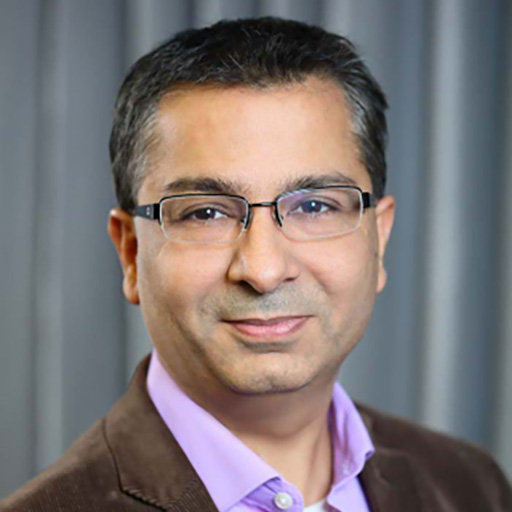
Now, I would like to introduce today’s guest speaker. Dr. Kapil Bharti is a senior investigator at the National Eye Institute, or NEI, and is the Scientific Director of the NEI Intramural Research Program, where he oversees 20 research labs and six core facilities. His lab at the NEI recently started the first U.S. Phase 1/2a trial to test autologous iPSC-derived RPE patch in AMD patients and developed the first digital twin of an eye cell, as well as 3D bioprinted eye tissue. He has published over 100 peer-reviewed manuscripts and reviews, given over 30 keynote and named lectures, and won several awards for his pioneering role in advancing the field of stem cell–based therapies. His current work at the NEI involves understanding mechanism of retinal degenerative diseases using induced pluripotent stem cell–derived eye cells and tissues and developing cell-based and drug-based therapies for such diseases. Welcome, Dr. Bharti.
DR. KAPIL BHARTI: Jimmy, thank you for having me. Really appreciate bringing me to this Macular Chat for BrightFocus Foundation.
DR. JIMMY LIU: Yeah, it’s really exciting to have you back on, Dr. Bharti. So, we’re going to start off with some questions. So, just as a note, today’s Chat will be an overview and will not mention any specific medical products or treatments, investigational therapies, or clinical trials. So, let’s begin by clarifying some terminology. We often hear the term “stem cells” used broadly. Can you explain the difference between stem cell therapy and cell therapy for our audience?
DR. KAPIL BHARTI: Jimmy, stem cell therapy and cell therapy, these are words often, as you point out, used interchangeably, but they are slightly different in their treatment options. Cell therapy, I would say, is a slightly broader term. In fact, both of them are what I would call “living drugs.” A living drug definition is something that, unlike a small molecule, would go inside your body and would stay there forever, potentially. And because it’s a living drug, it can change in its phenotype. It can interact with the host. It can change the host—as in the patient tissue—and it can change itself. So, there’s a lot of nuances to living drugs that are different from a small molecule–based therapy. And cell therapies and stem cell therapies both would fall in that category.
Cell therapies, I would say, if you take the example of a cell therapy, would be something like CAR T-cells. These are used as one of the newest technologies that’s used to treat cancer patients, where you take immune cells out of cancer patient’s body, you modify them, and make them attack the tumor in the patient’s tissue, and then you put them back in patients. So, that’s a classical cell therapy example. Other examples of cell therapy would be taking a tissue from a donor and putting the donor tissue into another person, and hoping that tissue would integrate into that patient. Now, in both of these approaches, these cell therapies are designed either to treat a disease or to repair a damaged tissue.
Now, stem cell therapies or stem cell–derived therapies can also do something similar. In fact, I would break the stem cell therapies into two further categories. One would be just stem cell therapies, in which you’re injecting stem cells. And I think the classical example that we know of is, for instance, everyone knows bone marrow or hematopoietic stem cell transplantation, which is given to leukemia patients or lymphoma patients. One of the more recent examples in stem cell therapies is mesenchymal stem cells, which are injected in patients to treat inflammatory and orthopedic conditions. Now, in both these cases, these are stem cells that have a very limited potential to make other cell types. For instance, we know that bone marrow stem cells or blood stem cells can only make blood cells, and they replace a patient’s blood because the previous blood had cancer. So that’s taken out, and the new blood is put in through the stem cells. Mesenchymal stem cells often would make probably cartilage and some of the mesenchymal tissue. So both of them have very limited potential to make other cell types.
Now, when I talk about stem cell–derived therapies, there we talk about making a tissue from stem cells. And one of the classical examples that, for instance, we do in our lab is making eye tissues from patients’ own stem cells called induced stem cells, and those induced stem cells can be converted into any tissue of the body—liver, heart, brain, and eye tissue, for instance. And in that case, we’re not transplanting stem cells into patients, but we’re transplanting the patient’s own tissue back into the patient. So, in this case, these are relatively pure eye tissues, which would, when they are transplanted and engrafted, would behave like a native tissue. And again, they would probably stay in the patient’s body forever. So now, technically, there are three different types of cell therapies that can come from just any cell type: stem cells, which are injection of pure stem cells, and then stem cell–derived therapies, which is stem cell–derived tissue, which does not typically contain any stem cells.
DR. JIMMY LIU: Perfect! Thank you so much, Dr. Bharti, for describing that distinction between stem cell therapies and cell therapies for our audience. The next question that we have is: Why is it important for listeners to understand that not all cell therapies involve stem cells, like what you alluded to? And then also, what are some common misconceptions that you encounter about stem cells and cell therapy?
DR. KAPIL BHARTI: Yes, I think misconceptions is a very important topic to discuss. Everybody, as soon as they hear “stem cells,” or “stem cell–derived therapies,” they think this is some kind of a magical cure they’re going to get. But unlike any other drug, these are also drugs that we are testing and making in the lab. We go through very rigorous testing in animal models before they’re given to patients, so I would say patients should be careful in asking the right questions, about whether what they’re getting is a bona fide stem cell therapy or not.
And that’s an important first misconception, when people see that the stem cells can automatically regenerate anything, and if a clinic is offering them, they must be approved and safe. That’s not always the case. There are cases where people are injecting stem cells—for instance, mesenchymal stem cells, which are known only to be injected in orthopedic conditions and inflammatory conditions—there have been cases where such stem cells have been injected in the eye. And as I mentioned earlier, because mesenchymal stem cells do not make eye tissue, they can actually cause harm to those patients, and in fact, there have been published reports of patients going blind because of those treatments. So I would really caution our patients to be careful about what they’re getting into, ask the right questions, ask if the therapy has been approved by the FDA to be tested in a Phase 1, 2, or 3 trial, which they’re enrolling into.
And then for that reason, that misconception that not every stem cell is a treatment is a very important one. They should ask what treatment are they getting? And if they’re getting a treatment in the eye, it is likely a stem cell–derived eye cell type that should be given to them, and, as I said, as part of an approved trial.
Now, the other misconception is that not every stem cell therapy is curative. Not every stem cell therapy is at a stage that is fully commercially approved as a treatment. Most of them are actually still under trial. So, patients should be careful in asking those questions, because depending on what stage of the trial they are, these stem cell therapies may still be testing for engraftment or for safety and feasibility aspects.
And I think last, but not least, is that it’s important to know that, just like any drug, stem cell–derived therapies also have inherent risk—often maybe a little bit more risk than perhaps a small-molecule drug because a small molecule will be cleared by your body within a few days, if not within a few hours. These stem cell therapies, as I mentioned earlier, are living drugs, and they have the potential to stay in your body forever. And if they interact with the body, if they change with time, they may be of course beneficial and that’s when we test them in the lab. We test that they will be beneficial and provide efficacy, but there may be cases where they may cause harm. So patients should really ask all these questions of any trial they’re enrolling in and enroll into the right trials based on qualified decisions.
DR. JIMMY LIU: Perfect. Thanks so much, Dr. Bharti, for that explanation. The next question that we have is: What is the goal of cell therapy as it relates to—and I know you talked about the distinction between cell therapies and stem cell therapies—but how do those therapies, especially cell therapy, relate to macular degeneration and specifically geographic atrophy?
DR. KAPIL BHARTI: Yeah, that’s a great point. I think maybe before we go into that, we should explain what is the cause for macular degeneration. As patients may know, and as you know very well, that macular degeneration is a disease which is often associated with age-related changes in the back of the eye in this tissue called the macula, which is responsible for our central and color vision. Now, the blindness is often caused by degeneration of the light-sensitive cells—the photoreceptor cells. But the photoreceptor cells in these patients die because a tissue behind the photoreceptor cells—called the retinal pigment epithelium, or the RPE—dies off. Now, this tissue has one function in all its life. It’s going to maintain health and integrity of photoreceptors—the light-sensing cells, right? So if RPE cells that are going to maintain the health and integrity of photoreceptors die off, which is what happens in macular degeneration, photoreceptors die.
So, the idea that we all had or many people had for a long time was if you could replace the RPE cells at the right time before the photoreceptors die off, you would stop photoreceptor degeneration, and the patients won’t go blind. Now, the idea as a stem cell therapy for macular degeneration is that you can make patients’ own RPE cells—the retinal pigment epithelium cells—from their stem cells, test them in the lab that they’re functioning properly, that they’re safe, that there’s no impurities left in them, and then you deliver them back into patients’ eyes as a transplantable tissue. Once it integrates, it can then protect the photoreceptors from dying further and then stop the patients from going blind. So that’s the treatment option that we and many others are testing, and we hope that if this works, this will be a game-changing treatment for macular degeneration.
DR. JIMMY LIU: Thanks so much, Dr. Bharti, for that explanation. And so, continuing on that conversation, more specifically, what are researchers currently hoping to learn from these early cell therapy studies that are being conducted right now?
DR. KAPIL BHARTI: Yeah, so as you point out, and as I mentioned earlier, most of these clinical trials are at early stages. They’re at Phase 1 or Phase 2. And Phase 1 and Phase 2 trials, by design, are testing mainly the safety, engraftment, and feasibility of the transplanted cells. What we hope is when we transplant them in patients, first of all, that there’s no adverse events caused by cells or any impurities, which we make sure that there won’t be any, but that still needs to be tested. And we will follow the patients for months to years to see if the cells continue to stay safe. And then at the same time, we want to see that the cells actually engraft in the back of the eye and stay stable. Again, it’s a living drug. We hope that it will stay for the rest of patient’s life in their eyes. And that’s what we’re following by doing this Phase 1/2 early-stage trial.
And the last bit is, of course, the feasibility logistics of the whole operations, enrolling the patients, making their cells in the lab, in a clean room, clean environment, transplanting them back, optimizing the surgical procedure, optimizing patients’ recovery from this, follow up with different modalities to see how the cells are engrafting, how the safety is happening. So there is a lot of logistics behind this, and all of that is done and uncovered during Phase 1/2 trial, and that’s where most of the studies are with respect to RPE transplantation for macular degeneration patients.
DR. JIMMY LIU: Thanks so much for that, Dr. Bharti. And what are some outcomes that cell therapy research is not expected to achieve right now at this stage of research, AKA these clinical or Phase 1/2 clinical trials?
DR. KAPIL BHARTI: I think everybody hopes that stem cell therapy will be curative, fully restorative of the visual defects the patients have, but at this early stage, because often the patients that enroll are at such a late stage of disease, it’s hard to say that the transplant will be curative at this stage. And the second reason is that because, as I mentioned earlier, we’re optimizing a lot of conditions in terms of surgery and manufacturing, so a lot of treatment possibilities are changing. So it’s hard to say that the cure or restorative treatment is really happening in this patient.
And by design, the patient enrollment number is relatively small in Phase 1/2 trials. So there’s no statistical power in these calculations to say whether the patient’s vision is really changing because of transplantation, or is it just a placebo effect due to surgery or due to any other environmental effects. So, that’s why I think, again, patients need to be cautious when they’re being enrolled in a trial and they’re being given a false promise that the transplant will completely cure them, completely reverse their visual decline. They need to be mindful, and they need to ask the right questions. It’s a very important thing that we don’t expect significant changes, curative changes, restorative changes in vision until we get to Phase 3 trials for most of these technologies.
DR. JIMMY LIU: One-hundred percent, Dr. Bharti. And that’s why resources on BrightFocus’ website and also this Macular Chat today will be really useful for individuals who are interested in learning more information about these therapies. The next question that we have is—and I know you talked a little bit about this before: Why do cell therapy treatments typically take so many years to evaluate before they can be considered for wider use? As you may know, patients always ask, “When can I get a treatment to help protect myself from losing more vision, etc.?” and things like that.
DR. KAPIL BHARTI: I get it, and I understand that when you lose vision, it’s a very desperate situation, and I understand the concerns patients have that it needs to move faster. But just stem cell therapies by design are relatively slow, and part of the reason is that it takes a long time to make cells from a patient’s own body, make their own tissue. It takes a long time to test them in the lab and in animal models. It can take months to years for this testing. And for every patient, we’re making their own tissue. It takes almost 6 months to make their own tissue, even in the clinical trial phase. And then we follow up with that patient just for safety reasons, at least for a year, and sometimes even longer. So you can imagine all this adds up time, and by the time you finish your Phase 1 trial, Phase 2 trial, it can be many, many years. And the other side of this is that this is a very expensive technology, because if you’re spending 6 months making one dose off a patient, it takes thousands of dollars to do that.
So, we have to raise money both from public donations or public organizations like the NIH, from private nonprofits like BrightFocus, and from many other places, including private funding to make sure that there’s enough resources to be able to do all of this work. And that’s why all of this adds up to time and resources. And it takes years to get to the stage when hopefully we’ll … but, my hope is that many of these will soon, within the next few years, will reach Phase 3 trials. And FDA has been very mindful of this, that it takes long time, and so hence, they are changing their policies that actually if there is enough promising results of safety, engraftment, and even early signs of efficacy in Phase 1/Phase 2, they might consider Phase 3 as a potential commercial approval trial and as what is called a registration trial. So I think this will help bring the technologies faster to patients who desperately need them.
DR. JIMMY LIU: Perfect. Thanks so much, Dr. Bharti, for explaining the process and the lengthy time it takes to get something from the bench all the way to the patient. So, continuing on that, kind of at the back end of what you just described: Can you walk us through what the surgical delivery process looks like for cell therapy, and in particular, procedures like subretinal implantation?
DR. KAPIL BHARTI: Yeah. So, subretinal implantation, as the name suggests, it’s a slightly more invasive procedure than your regular injection that you would get in the eye—an intravitreal injection—or obviously, much more invasive than taking eye drops. But it’s a standard procedure that has been worked out very well. It takes about a couple of hours to go through this procedure where the surgeon would go through the side of the eye, remove part of the vitreous, and then make a small incision in the retina, and deliver the transplant under the retina, or in some cases, deliver the cells in suspension under the retina as an injection. And most retina surgeons are skilled to perform this procedure. We are obviously continually training more and more surgeons to do this advanced procedure. It is considered advanced surgical procedure, but I think it’s getting to the point that this procedure itself is becoming a regular and relatively safe practice.
DR. JIMMY LIU: And then, adding on to that: What are some of the general risks that patients should be aware of with a surgical procedure like this?
DR. KAPIL BHARTI: General risk, I think, as it is with any surgical procedure, one of the biggest risks is, of course, infection, right? We have to be mindful that a cut is made, there’s a wound created in the eye, and like any cut, even on your knee, can be infected. So, one has to take care of that cut, take care of that incision, let the eye heal. But there are very standard procedures to make sure that there is no infection happening in this case. And it’s done, of course, in surgical suites in clean areas—a so-called sterile zone of surgical suites.
But there’s also other concerns, like inflammation in the back of the eye. Macular degeneration itself is an inflammatory condition. Now on top of that, you’re doing surgery, and you’re inserting instruments, and you’re delivering cells that can cause inflammation, so patient’s eyes need to be taken care of for that. But there are drugs like steroids and others that are given to those patients to reduce inflammation.
Now, there are two different types of cell therapy possibilities. Autologous, which is made from patients’ own cells, which is less likely to cause an immune reaction against the cells, but then the other one would be allogeneic, which means a healthy person’s cells are delivered into patient’s eyes. A healthy person’s stem cells made into eye cells are delivered into patient’s eyes. And that has the potential to cause immune rejection. For that reason, those patients may also get additional drugs to suppress their immune response. But as I’m alluding to that, there are these risks, infection, inflammation, with all these procedures, complications in surgery, but there are sufficient drugs and sufficient procedures in place to contain all of these and to reduce the risk of all of this happening for patients.
DR. JIMMY LIU: Thanks so much for that, Dr. Bharti. And then, in terms of current treatment options for AMD: What might the long-term treatment approach look like for cell therapy compared to those current treatments for AMD?
DR. KAPIL BHARTI: Yeah, so for dry AMD, or for AMD in general, some of the injections, some of the treatments require injections that reduce disease burden, if you will. Whereas cell therapies, as I mentioned earlier, too, are restorative, are curative. The goal of these cell therapies, especially transplantation of RPE cells, is not to just reduce inflammation. It is to replace degenerative and damaged tissue. It is a long-term treatment. It will hopefully … and the other side of this is, unlike injections, which are to be given more frequently, these cell therapy treatments are supposed to be one time and forever and the cells are supposed to stay forever. So, that’s a big difference, and I think that’s also thought of the biggest hope of cell therapies, that they will restore the damaged tissue and the patients won’t have to go back to clinic once the graft is fully engrafted in the back of the eye, patients won’t have to go back to the clinic ever again.
DR. JIMMY LIU: That’s awesome, and something that’s going to be really exciting for patients to look forward to. So thanks for that, Dr. Bharti. I know you talked a lot about the process and all the research behind cell therapies, and so some patients might ask: How long do researchers and clinicians expect that the transplanted cells might last once they are placed into the eye?
DR. KAPIL BHARTI: Yeah, so as I just mentioned, I think the hope is—it is a hope. We have yet to see the results of this because we haven’t seen enough transplants, but the hope is that the transplanted cells will last in patients’ eyes forever, and it’s a one-and-done deal. Patients go to the surgery room, get their transplant, and recover from the surgery in a day or two. Recovery from the healing process of the wound takes another couple of weeks. And once they’re fully healed, and it takes the cells to get engrafted in the back of the eye, maybe another few weeks to maybe a couple of months. And if they’re engrafted, the hope is they will stay forever, and especially autologous, they may stay forever for sure, but at allogeneic as well, there is some strong evidence that they may stay long in patients’ eyes, and immune suppression may not be needed forever. So, we are all looking forward to that happening one day.
DR. JIMMY LIU: Thanks so much for that, Dr. Bharti. And so, going back to what you talked about earlier: What advice would you give listeners to help them recognize the difference between legitimate clinical trials and unregulated stem cell clinics?
DR. KAPIL BHARTI: Jimmy, this is a very important point, and I often educate our patients and listeners on this topic. They have to be very careful. Not every stem cell is a legitimate treatment, and as I mentioned earlier. If the wrong cells are delivered in the wrong place at the wrong time or with the wrong procedure, patients can be harmed, and there have been many cases where patients have gone blind because of just the wrong treatment. So, what are the warning signs? First of all, please ask, always: Is this an FDA-approved clinical trial? Look for documentation. Is it a legitimate clinic? And ask for that documentation.
Another thing to ask for is: Are they charging you anything? If you’re enrolling in a Phase 1, 2, even a 3 trial, they should not be charging you. If it’s an approved therapy, there should be a plan to charge your insurance and Medicare, or other places, but they should not be asking you to pay out of your pocket immediately. So ask for those things. Those are the big red flags. If a place is saying, “Give me $25,000, I’ll do an injection in your eye, and you will be better in 2 days,” that’s probably not the right place for getting approved stem cell therapy. So please be mindful. It can be dangerous. Not every stem cell therapy is restorative. Some unapproved therapies can be harmful.
DR. JIMMY LIU: Absolutely, and I totally echo your statements, Dr. Bharti, about patients on the line being very mindful about looking up very detailed information about these trials to make sure that they are getting the correct thing. Continuing on with that: How is eligibility for a cell therapy trial determined, and what factors typically influence who can participate?
DR. KAPIL BHARTI: I think eligibility would depend on the trial itself, the design of the trial, and the stage of the trial. For instance, as I mentioned earlier, if it’s a Phase 1 study, in a Phase 1 study, FDA only allows you to enroll very late–stage patients. So if a patient’s vision had just started to decline, they may not be eligible for a Phase 1 trial. They may have to be late-stage patients. Vision would have to be significantly lower to be enrolled in a trial, but if it was a Phase 2, maybe Phase 3 trial, even patients with a slightly earlier stage of disease may be eligible for the trial. The other criteria may be related to other diseases they may have. For instance, if they have to be given a very strong immunosuppressant, and at the same time they have ongoing treatments for cancer and kidney disease, those may be affected by the immunosuppressant. So all of those things may affect the trial.
So again, talk to the surgeon, talk to the PI—the principal investigator—of the trial. Tell them about your other conditions you may have. Have them look at your medical records. Discuss with them. Discuss with a second person. Make sure you make informed decisions so that the trial is actually helpful for you and is the right trial for you. If you’re enrolled in a wrong trial where the drug’s given to reduce inflammation because of surgery and all that may harm you, that may not be the right trial for you.
DR. JIMMY LIU: Thanks so much for that information, Dr. Bharti. Our last question that we have is: What are you most excited about in the field of cell therapy? And an added question to this is: What are your feelings about when these therapies will be commercially available to the public?
DR. KAPIL BHARTI: Yeah. And, Jimmy, that’s what I’m most excited about. I think in the next 4 to 5 years, even sooner, we might see some therapies reaching a commercial stage. There’s a lot of trials right now. I think at least worldwide, around 10, maybe more than 10-12-ish—and in the United States itself, about four or five trials that are all at, like, Phase 2 stage, Phase 1 or 2a stage, and many of them are showing promising results. So I’m hoping that in the next 2 to 3 years, these will be reaching Phase 3. And as I mentioned earlier, FDA is now changing their policies that if the results are promising, they may allow Phase 3 as a registration or commercial trial. And that’s what I’m most excited about. Many of us have been working in this space for many years, over a decade and a half, and we want to see some results of the efforts of hundreds and thousands of people who have been working in this area to get to a treatment that actually works for AMD patients. So, I’m hopeful and I’m excited that this will happen. We have been very cautious. We have been very careful in taking all the steps, but I want to see some good results in the coming years.
DR. JIMMY LIU: Thanks so much for that, Dr. Bharti. I think all of us at BrightFocus and myself are also super excited about all the potential that these therapies can bring to us in the near future, especially to patients. It’s going to be—fingers crossed—hopefully soon. So, that’s all the time we have for questions today. Thank you so much again, Dr. Bharti for answering so many of our questions and all the information you shared with us today. I would like to mention that our website, www.brightfocus.org, has a wealth of information about macular degeneration. Also, if you would like more information on clinical trials for AMD, please contact BrightFocus. You can reach us by calling our toll-free number, (855) 345-6637. Dr. Bharti, before we close, do you have any final comments or anything for our audience?
DR. KAPIL BHARTI: Jimmy, I think I’ve shared a couple of important pieces of information, which is for patients to be mindful what kind of trials they want to enroll in, to be extremely careful about unapproved stem cell therapies, and, at the end of the day, be hopeful. I think we are almost there. Within the next few years—we are close to the finish line—we will have, hopefully, more than one at least, if not more than one stem cell–based therapies that will have a strong restorative potential for macular degeneration patients. And at the end of the day, Jimmy, thank you for inviting me to this Macular Chat. I really had fun chatting with you.
DR. JIMMY LIU: Awesome! I had so much fun catching up and chatting with you, Dr. Bharti. It’s been really awesome. So, thank you so much, again. Our next Macular Chat will be on Wednesday, May 27, 2026. Thanks again for joining us, and this concludes today’s Macular Chat.
Useful Resources and Key Terms
BrightFocus Foundation: (800) 437-2423 or visit us at www.brightfocus.org/. Available resources include—
Resources for Macular Degeneration
Helpful terms mentioned during the Chat include—
- stem cell: a type of cell that can make more cells like itself or that can become other types of cells that do different functions
- immune rejection: when a person’s immune system tries to attack transplanted tissue
- types of therapies:
- cell therapy: modifying a patient’s own cells and putting them back in the patient or performing donor tissue transplantation
- stem cell therapy: injecting stem cells into the patient
- stem cell–derived therapy: transplanting tissues that are created from stem cells but that no longer have any stem cells in them
- autologous cell therapy: treating a condition using the patient’s own cells
- allogenic cell therapy: treating a condition using cells from another person
- small molecule–based therapy: using a specific class of drug that can enter cells easily
- subretinal implantation: transplanting cells into the eye
- intravitreal injection: injecting medication into the eye
- eye drops