A new study funded by BrightFocus Foundation’s National Glaucoma Research program has revealed a promising new therapy for glaucoma that helps protect neuronal cells in the retina from dying. In a study published in Cell Death & Disease, National Glaucoma Research grantee Marco Feligioni, PhD, and colleagues found that the inhibitor JGRi1 blocked the harmful effects of excess glutamate and significantly improved neuronal survival in lab models1.
In glaucoma, retinal ganglion cells (RGCs) are lost, leading to vision loss because the eye can no longer properly transmit visual signals to the brain. The best-known risk factor is high pressure inside the eye, but it is still unclear how high pressure leads to RGC death. Another harmful mechanism is an excess of glutamate, a molecule that normally helps nerve cells communicate but is toxic at high levels. Developing drugs that can block the harmful effects of excess glutamate could help protect these cells and preserve vision.
“The National Glaucoma Research grant helped us to concentrate our efforts on a deep dive to better understand how we could all benefit from the use of JGRi1 in eye pathologies,” said Dr. Feligioni. “Before BrightFocus, the work we had done on how JGRi1 works in eye pathology was very preliminary. This grant was the bridge that took us from a clever idea to real therapy.”
According to Dr. Feligioni, no neuroprotective drug for glaucoma has reached the clinic for decades, and this discovery represents a “paradigm shift” in how we look at glaucoma treatment.
An easy-to-use eye drop
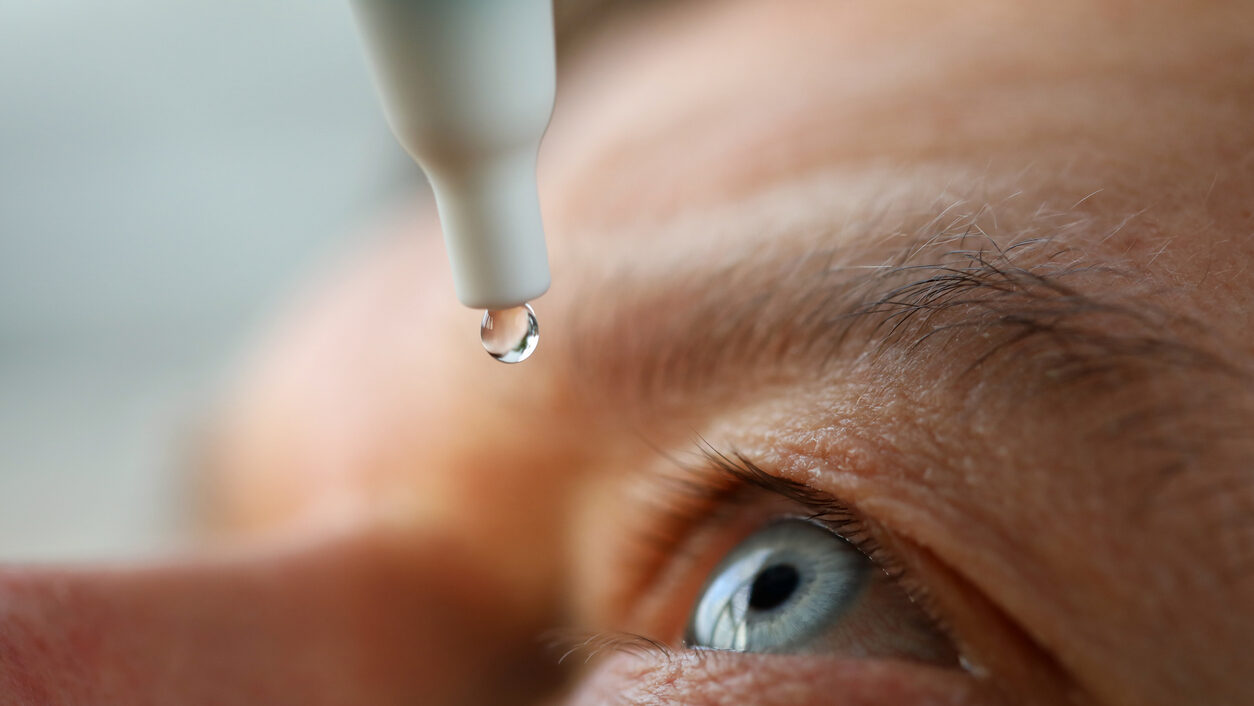
For people living with chronic conditions such as glaucoma, having medications that are simple and easy to use is especially important. Eye drops are an ideal option because they avoid eye injections, which many people find uncomfortable. They also eliminate the risk of side effects caused by medications taken by mouth or body injection, which must travel throughout the body before reaching the eye. To that end, Dr. Feligioni’s team tested their JGRi1 inhibitor in an eye drop formulation.
When the researchers administered the drug in lab models via topical eye drops, JGRi1 reached the retina and showed protective effects without the need for injections. Dr. Feligioni said that these experiments helped the team answer two important questions: “One: Does it get in? We proved JGRi1 eye drops actually reach the retina; and two: Does it protect? We proved it rescues retinal cells in two different injury models.”
He added: “The BrightFocus grant represented the right push forward for our project, which we now want to boost as much as we can to develop this drug for human use.”
Differentiating normal glutamate signaling from toxic responses
Under normal conditions, glutamate works as a chemical signal that helps neurons communicate (also known as a neurotransmitter). RGCs, the neuronal cells that transmit visual signals from the retina to the brain, rely on glutamate for normal communication but can be damaged when too much of it builds up in the retina.
“Previous drugs failed because they blocked the [entire] glutamate network, not only its toxic activity that is harmful for cell life, causing side effects,” said Dr. Feligioni. He focused on identifying a way to block only glutamate’s toxic effects, while keeping its physiological function intact—a differentiated and more precise approach than what had been achieved previously.
The researchers discovered a specific signaling interaction between two neuronal proteins that was activated only when there was too much glutamate present. After many experiments in the lab, the team also found a way of blocking this with a peptide (a small protein) that acts as an inhibitor: JGRi1.
When tested in two lab models of retinal degeneration, this inhibitor protected RGCs from cell death. And, importantly, in the retina, JGRi1 did not affect normal glutamate processes and only blocked the specific mechanisms involved in the cells’ response to excess glutamate.
What’s next: from the lab to the clinic
Dr. Feligioni envisions JGRi1 being used as an add-on therapy in the clinic, not a full replacement for current treatments. He also anticipates JGRi1 being used by individuals with glaucoma who cannot tolerate pressure-lowering drugs, or who continue to lose vision even with a normal eye pressure. In those cases, “our neuroprotective treatment would be a game-changer,” he said.
More research is still needed before JGRi1 could reach the clinic. Scientists must first confirm its long-term safety, turn the lab peptide into a stable molecule to add to a sterile eye drop, and run more tests in lab models before conducting clinical trials in people. “The road is long but clear,” said Dr. Feligioni. “If this works, it could be as simple as adding one more drug in the drops used in their daily routine.”
Dr. Feligioni added: “Glaucoma is the silent thief of sight, and because of this [BrightFocus] grant, we have real evidence we might finally have a way to stop the theft before it’s too late.”