Targeting Genetic Triggers of Inflammation in Alzheimer's Disease
A BrightFocus Alzheimer’s Disease Research-funded scientist is investigating how a class of “jumping genes” may fuel brain inflammation in Alzheimer’s—and whether blocking them could prevent or slow dementia.
Dr. Herdy is a recipient of a 2025 Alzheimer’s Disease Research grant. BrightFocus Foundation recently announced 28 new Alzheimer’s Disease Research grants, totaling over $7 million in funding for 2025. These awards support cutting-edge projects designed to protect sight and work toward a cure for Alzheimer’s. Learn more.
Alzheimer’s disease robs millions of memories, independence, and connection with loved ones. While much of the research field has focused on amyloid and tau, scientists are uncovering new drivers of the disease—including chronic brain inflammation.
BrightFocus Foundation Alzheimer’s Disease Research grant recipient Joe Herdy, PhD, is studying an unexpected culprit: a class of “jumping genes” known as LINE-1. These viral-like pieces of DNA can reactivate later in life, triggering immune responses in the brain that resemble infection but arise from within.
By understanding and blocking this process, Dr. Herdy hopes to uncover new ways to protect brain cells and slow Alzheimer’s. Keep reading to learn how his unique scientific journey—from studying jawless lampreys to cutting-edge neuroscience—is opening bold new doors in dementia research.
What inspired you to investigate jumping genes and brain inflammation in Alzheimer’s disease?
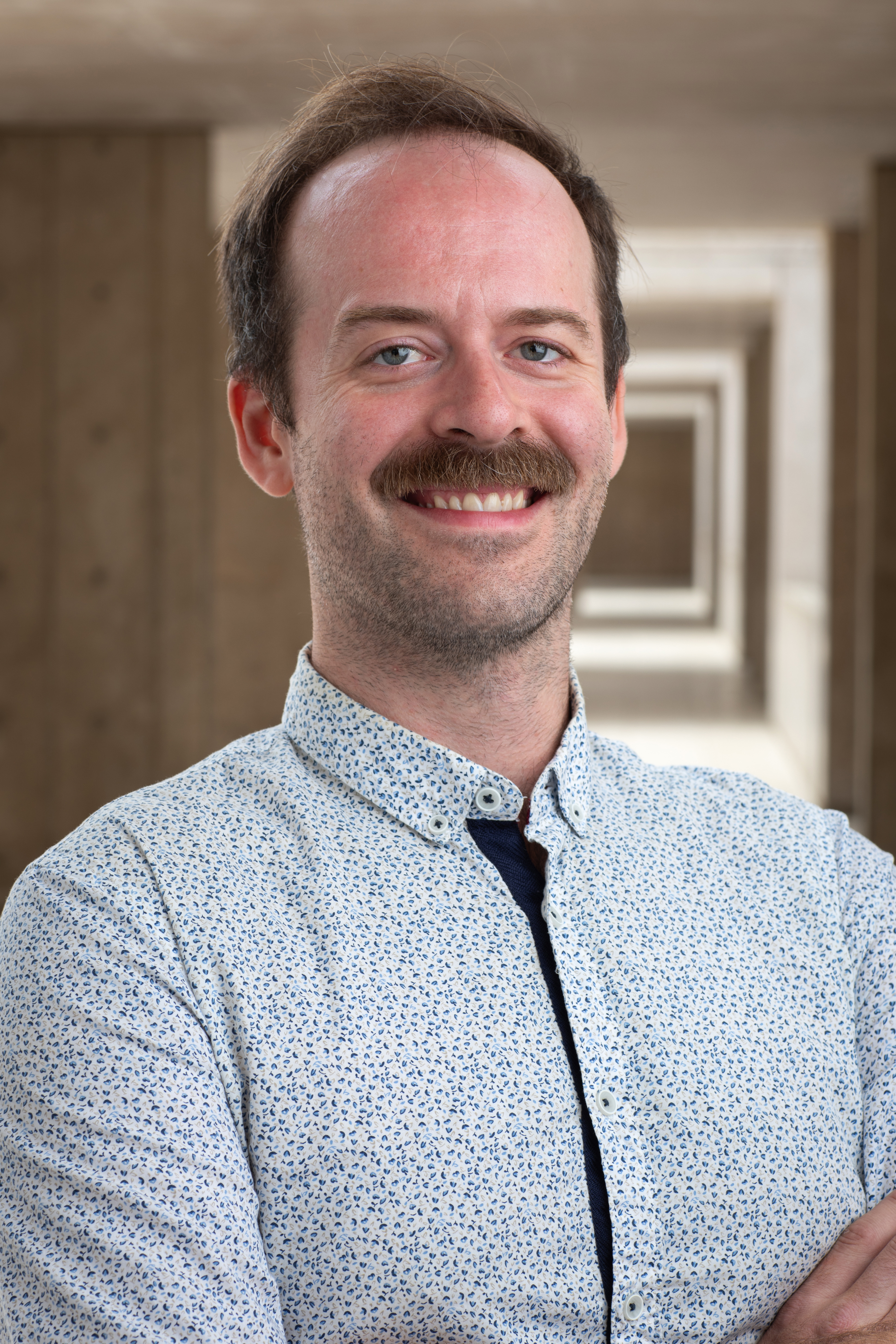
Alzheimer’s Disease Research grant recipient, Joseph Herdy, PhD
My route to jumping genes in Alzheimer’s disease was not at all direct. During my master’s at the University of Kentucky, I was studying the genetics of sea lamprey. They’re sort of terrifying eels without jaws that have tooth-filled sucker mouths and parasitize fish. One of the many strange things about lamprey is that they delete ~20% of all the DNA from the cells that make up their body, and they retain this DNA only in sperm and egg cells. When an individual has differences in the DNA between cells in their body, it’s called a genomic mosaic, where just like a mosaic decoration, the individual tiles are cells that have different DNA content.
Here at the Salk Institute, my mentor Rusty Gage discovered that there’s another type of genomic mosaicism that occurs in human brains, caused in this case by the jumping gene “LINE-1”. LINE-1 can jump around the genome and copy and paste itself, almost like a virus, and when this happens during brain development and aging it leads to differences between individual neuron’s genome and the brain itself becomes a genomic mosaic. Back in 2022, we identified that certain neurons in the Alzheimer’s brain turn into senescent, zombie-like cells and become inflammatory. However, the mechanism by which senescent neurons become inflammatory was a mystery.
Now, we’ve returned to this idea of jumping genes and are testing if the intermediate steps in the copy-paste life cycle of LINE-1 are being interpreted as a viral infection by the host cell and triggering an immune-related inflammatory response. So really, it was ultimately my work with blood sucking sea lamprey that led me here!
Why is this work important to you, and what difference could it make for people with Alzheimer’s?
This work is important to me because it offers a potential new avenue for treating Alzheimer’s disease. In recent years, I think there has been a growing appreciation for features of Alzheimer’s outside of the classic amyloid beta and tau pathologies, but exactly how those relate to disease progression or neurodegeneration is just starting to be explored. Our results so far point to an interesting link between senescence and neuroinflammation in the brains of people with Alzheimer’s, and by the end of this study, we hope to have validated strategies to publish for the world to see on how to target these cells for use in future clinical trials.
When I began my scientific career, I honestly would have never guessed that I would end up in the field of cellular neuroscience. From a young age, I was interested in life and the natural world, and my fourth-grade self was fully prepared for an exciting occupation as a marine biologist chasing fish and measuring plankton. I think my trajectory really changed sometime in the early 2000s when I learned about the first sequencing of the human genome. I was immediately fascinated by the concept that 3 billion “letters” could contain the raw information that impacts so much of our lives, and I have been down the road of genetics ever since.
Later in life, I watched as my grandfather, who had lived much of his later years with diabetes, began to decline. The once sharp, witty engineer became slowly clouded and unreachable, and it was difficult and painful to see him lose himself and the effect that had on the rest of the family. Although there was always the implication that something about his diabetes management was contributing to his dementia, neither my family nor his doctors were able to find a solution before he passed. So many families have a similar story, and this experience has inspired me to look for solutions so others don’t have to feel the same sense of helplessness.
How does this project advance our ability to understand, detect, or treat Alzheimer’s?
This project advances our understanding of Alzheimer’s disease by establishing a mechanistic link between a classic aging feature, cellular senescence, and the activation of chronic inflammation in Alzheimer’s disease. Although there is consensus now that chronic inflammation is a hallmark feature of the Alzheimer’s disease brain, there is still very little known about exactly how this begins. I hope this study with the BrightFocus Foundation sheds some light on how senescent neurons initiate this process, with the ultimate goal of intervening to prevent it from progressing.
What do you hope this research project will lead to? What do you imagine the next step being?
I hope that this project leads future clinical teams to begin trials with reverse transcriptase inhibitors or other LINE-1 targeting drugs to treat Alzheimer’s. Although we have shown these treatments to be effective in vitro, one of the main limitations is the ability to cross the blood-brain barrier. In fact, HIV patients who are on these drugs for years show reduced likelihood of developing dementia, but the levels of the drug that make it into the brain are much lower than in peripheral organs and therefore likely less effective in patients who are already experiencing some cognitive decline. It will be exciting to see the methods other clinical teams can take to better deliver these therapies to the brain.
How will the funding from Alzheimer’s Disease Research, a BrightFocus Foundation program, advance your research or open new doors that wouldn’t be possible without donor support?
The funding from BrightFocus Foundation has been absolutely critical for advancing this project. We have a very exciting two years of experiments planned that involve cutting-edge technologies, including long-read single-cell sequencing, spatial transcriptomics, and advanced cell culture systems with neurons, microglia, and astrocytes. The datasets generated by the end of this fellowship will be the first of their kind in the world, and I am very eager to see what we learn! Science always invites more questions, and we hope to take what we learn to develop even more targeted interventions of LINE-1 mediated inflammation, and study what effects it could have in non-neuronal cells.
BrightFocus Foundation is a premier global nonprofit funder of research to defeat Alzheimer’s, macular degeneration, and glaucoma. Since its inception more than 50 years ago, BrightFocus and its flagship research programs—Alzheimer’s Disease Research, Macular Degeneration Research, and National Glaucoma Research—has awarded more than $300 million in research grants to scientists around the world, catalyzing thousands of scientific breakthroughs, life-enhancing treatments, and diagnostic tools. We also share the latest research findings, expert information, and resources to empower the millions impacted by these devastating diseases. Learn more at brightfocus.org.
Disclaimer: The information provided here is a public service of BrightFocus Foundation and is not intended to constitute medical advice. Please consult your physician for personalized medical, dietary, and/or exercise advice. Any medications or supplements should only be taken under medical supervision. BrightFocus Foundation does not endorse any medical products or therapies.
New Clues in the Fight Against Alzheimer's: Q&A with Dr. Keith Hengen
During World Alzheimer’s Month, Alzheimer’s Disease Research grantee Dr. Keith Hengen joined BrightFocus’ Dr. Sharyn Rossi on Instagram Live to talk brain health—how the brain functions, why quality sleep matters, and tips to keep your brain healthy.
Article
Home-Based Alzheimer's Treatment Brings Care Closer to Families
A team of BrightFocus Alzheimer’s Disease Research-funded scientists is exploring how home-based brain stimulation could improve memory, mood, and daily life for people living with Alzheimer’s disease.
Article
The Early Alzheimer's Signals We've Been Missing (Until Now)
Using advanced genetic sequencing, BrightFocus Alzheimer’s Disease Research-funded scientist Dr. Mark Ebbert is identifying overlooked changes in the brain that could finally unlock a way to diagnose Alzheimer’s before it begins.
Article
New Blood Test Could Personalize Alzheimer's Treatment Like Never Before
A new Alzheimer’s blood test may reveal how far the disease has progressed and identify who’s most likely to benefit from anti-amyloid therapies.
Article
What Early-Life Brain Activity May Reveal About Alzheimer's Risk
BrightFocus Alzheimer’s Disease Research grant recipient Keith Hengen, PhD, is pioneering a novel approach to identifying Alzheimer’s risk in early life, which could enable earlier diagnosis, risk reduction, and treatment.
Article
Does Disrupting the Brain's Clock Influence Alzheimer's?
An Alzheimer’s Disease Research-funded researcher is investigating the link between circadian rhythm disruption by jet lag and Alzheimer’s in the hopes of finding new treatment targets.
Every Donation is a Step Forward in the Fight Against Alzheimer’s
Your donation powers cutting-edge research and helps scientists explore new treatments. Help bring us closer to a cure and provide valuable information to the public.