PRIMA Implant Brings Vision Restoration Within Reach
Now available in Europe, the PRIMA implantable device may help improve vision in advanced age-related macular degeneration. Learn how it works and when it could be available in the U.S.
An innovative prosthetic retinal implant, PRIMA, is the first device of its kind to improve vision in people with geographic atrophy, an advanced stage of dry age-related macular degeneration.
The device was recently approved for commercial use in Europe.
The U.S. FDA granted PRIMA Humanitarian Use Device designations, expediting its regulatory pathway, but the device still awaits FDA review and authorization before becoming available in the United States.
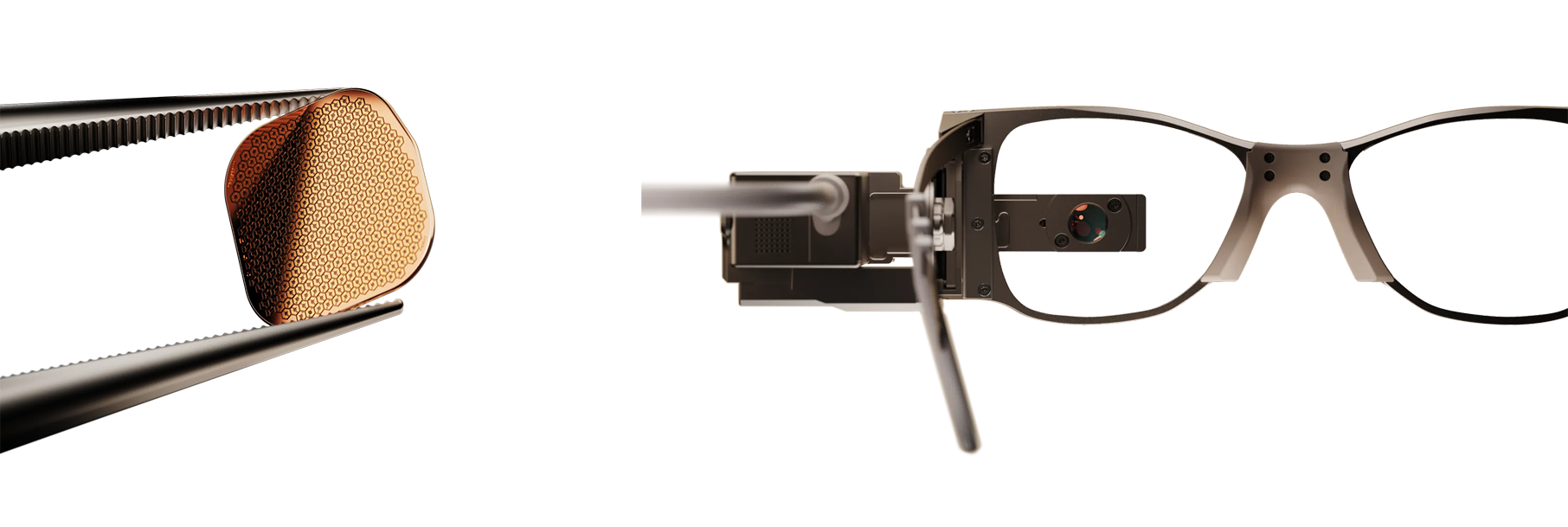
The PRIMA implant (left) has 378 light-powered pixels that convert light sent by the glasses (right) into signals that stimulate cells in the retina. Photo courtesy of Science Corp.
A breakthrough retinal implant called PRIMA is redefining what may be possible for people with advanced age-related macular degeneration (AMD) and other blinding diseases. Unlike current therapies, which can only slow disease progression, PRIMA has been shown to improve visual function in people with retinal degeneration.
The implant is now commercially available in Europe, having received a CE mark under the European Union Medical Device Regulation which authorizes its commercial use across 30 European countries. Here’s what to know about PRIMA and when it might be available in the U.S.
What we know about the PRIMA implant
PRIMA is an investigational retinal implant designed to help people with the advanced form of dry AMD known as geographic atrophy, particularly those who have lost central vision because the light-sensing photoreceptor cells in the macula have died, explained Dr. Frank Brodie, retinal specialist and vitreoretinal surgeon at the University of California, San Francisco and medical director of vision programs at Science Corporation, which manufactures the device.
It’s designed to replace the function of damaged photoreceptors—the light-sensing cells that are lost in diseases such as geographic atrophy. Unlike current treatments that slow disease progression but do not restore vision that has been lost, the implant is intended to restore the retina’s ability to convert light into electrical signals that can be sent to the brain.
The technology combines:
A tiny wireless chip implanted beneath the retina.
Special glasses equipped with a front-facing camera and eye-facing infrared projector that shines light on the implant.
External image-processing technology that sends visual information to the implant.
The device, which is typically implanted in one eye, acts like a miniature solar panel, powering itself from near-infrared light projected through the glasses. It contains 378 electrodes that convert light patterns into electrical signals. These signals stimulate surviving bipolar cells in the retina, which then send visual information to the brain. The system effectively bypasses damaged photoreceptors while using the eye’s remaining neural pathways, Dr. Brodie explained.
“The development of the PRIMA retinal implant is an exciting avenue for people who suffer from dry AMD and other retinal degenerations to recover meaningfulfunctional vision,” said Jimmy Liu, PhD, director of vision science programs at BrightFocus.“This technology, along with other promising vision-restoring treatments like cell therapy and gene therapy, is bringing new hope to those affected by AMD.”
How it can help people with geographic atrophy
For people with geographic atrophy, PRIMA is intended to restore aspects of central vision, which is critical for tasks such as:
Reading
Recognizing letters and numbers
Identifying objects
Performing everyday visual tasks
Users still require rehabilitation and training to learn how to interpret the visual signals produced by the implant and integrate them with their remaining natural vision. While PRIMA can help people with several day-to-day tasks, it is unlikely to expand the field of vision wide enough for users to resume driving, Dr. Brodie said.
Who is the ideal candidate for PRIMA?
PRIMA is designed for people of all ages who have lost photoreceptors but still have healthy inner retinal cells, particularly the bipolar and ganglion cells that process and transmit visual information, Dr. Brodie shared. The technology has been studied primarily in people with geographic atrophy from advanced dry AMD, but researchers believe it could potentially help people with other diseases that cause photoreceptor loss, such as Stargardt disease.
While the device is not currently effective for wet AMD, a more severe form of the disease that involves the growth of leaky blood vessels in the retina, Dr. Brodie said they plan to study it in the future.
“We picked geographic atrophy initially because we know that the overlying cells are not disturbed. We really need those bipolar cells and ganglion cells to be in great shape to get your best vision out of PRIMA. In wet AMD, it’s a little bit more heterogeneous. Some patients absolutely will have great overlying cells, but some patients, unfortunately, that have had a lot of bleeding and exudation from the wet AMD will have a little bit less function in those cells,” he said.
Clinical trial results
The first U.S. implantation of a PRIMA device was performed at the University of Pittsburgh Medical Center in 2020, following an initial first-in-human study launched in France in 2017.
In October 2025, researchers published results from the PRIMAvera trial in The New England Journal of Medicine. Conducted in Europe among 17 surgeons in five countries, the trial found that most patients achieved meaningful improvements in prosthetic visual acuity and many regained the ability to read letters, numbers, and words.
“Patients were able to regain the ability to read—not fast, not quickly—but they really could start to read again using a retinal prosthesis, which was a first-of-its-kind breakthrough and very, very exciting for us to see as clinicians,” Dr. Brodie said.
What’s next for approval in the United States?
PRIMA has not yet received FDA authorization for use in the U.S. It Its manufacturer, Science Corporation, is working with the FDA and must submit the clinical safety and effectiveness data required for a marketing application. In July 2026, the FDA granted PRIMA two Humanitarian Use Device (HUD) designations, which recognize its potential to help people with rare conditions and may help expedite its regulatory pathway. However,the device must still be reviewed and approved by the FDA via a Humanitarian Device Exemption.
While the timeline for U.S. availability remains uncertain, Dr. Liu estimates that PRIMA could potentially be available in the U.S. in the next couple of years.
“We’re working very, very hard with the FDA here in the United States to show them our data from the trial and bring it to patients in the United States as fast as possible,” Dr. Brodie said.
“I’m hopeful that in the very near future implantable devices such as this will enable individuals to fully regain vision nearly the same as before they lost their vision to AMD,” said Diane Bovenkamp, PhD, vice president, scientific affairs at BrightFocus.
Want to learn more about PRIMA and how retinal implants work?Listen to our full conversation with Dr. Brodie, part of BrightFocus’ Macular Chats program.
About BrightFocus Foundation
BrightFocus Foundation is a premier global nonprofit funder of research to defeat Alzheimer’s, macular degeneration, and glaucoma. Since its inception more than 50 years ago, BrightFocus and its flagship research programs—Alzheimer’s Disease Research, Macular Degeneration Research, and National Glaucoma Research—has awarded more than $330 million in research grants to scientists around the world, catalyzing thousands of scientific breakthroughs, life-enhancing treatments, and diagnostic tools. We also share the latest research findings, expert information, and resources to empower the millions impacted by these devastating diseases. Learn more at brightfocus.org.
Disclaimer: The information provided here is a public service of BrightFocus Foundation and is not intended to constitute medical advice. Please consult your physician for personalized medical, dietary, and/or exercise advice. Any medications or supplements should only be taken under medical supervision. BrightFocus Foundation does not endorse any medical products or therapies.
Treatments
Vision Restoration
Share this post
Resources
Related Articles and Information
Expert Information
AREDS2 Eye Vitamins: What They Do, Who Should Take Them & What the Research Shows
What AREDS2 eye vitamins do, who should take them, and what the research says about slowing macular degeneration.
Expert Information
Gene Therapy Advances in Age-Related Macular Degeneration
Gene therapy treatments may one day free people with age-related macular degeneration (AMD) from the need for frequent eye injections.
Downloadable Resource
Helpful Resources for Macular Degeneration Care
Resources and information that provide products, services, and other support for people with macular degeneration and their families.
Expert Information
How Retinal and Brain Implants Restore Partial Sight
Artificial vision systems utilizing these technologies show promise for individuals with profound vision loss in early trials.
Expert Information
Emerging Treatments Offer New Hope for Dry and Wet Age-Related Macular Degeneration
Promising new treatments in late-stage clinical trials could transform how we treat age-related macular degeneration.
Downloadable Resource
Treatments for Macular Degeneration
Find information on treatment options for dry and wet age-related macular degeneration.