Transforming Macular Degeneration Care With Long-Acting Treatment
With funding from Macular Degeneration Research, Dr. Daisy Shu is exploring advanced drug delivery systems that release medicine slowly over time. This innovative approach could reduce the number of injections needed for macular degeneration while maintaining vision-saving results.
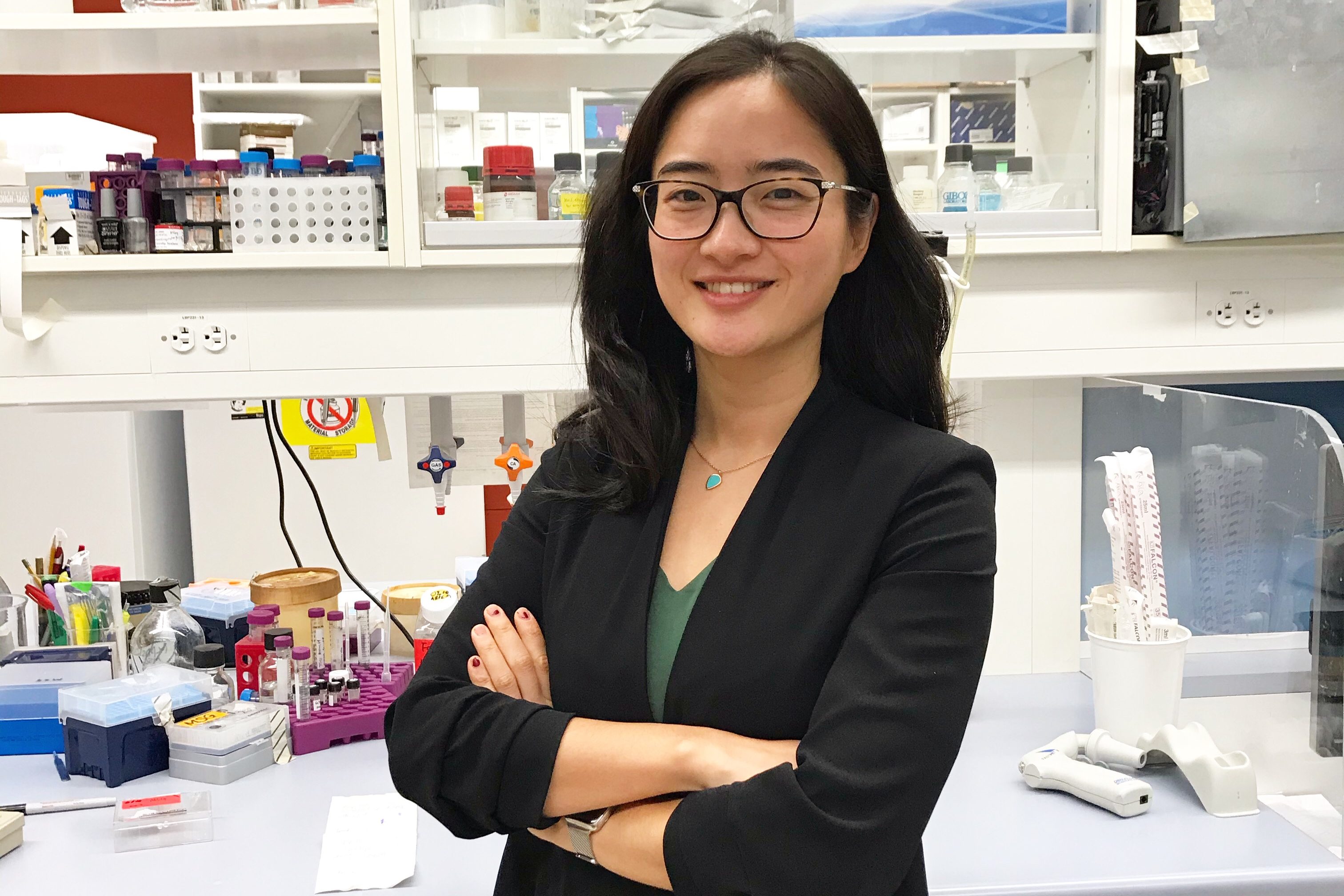
Macular Degeneration Research grant recipient Daisy Shu, PhD
Dr. Shu is a recipient of a 2025 Macular Degeneration Research grant. BrightFocus Foundation recently announced 12 new Macular Degeneration Research grants, totaling over $3.7 million in funding for 2025. These awards support cutting-edge projects designed to protect sight and work toward a cure for macular degeneration. Learn more.
Age-related macular degeneration (AMD) is a leading cause of blindness, robbing millions of people of their central vision. Current treatments for wet AMD, the more advanced form of the disease, often require eye injections every four to eight weeks—an ongoing burden that is stressful, costly, and challenging for people living with AMD and their families. While these therapies can slow the disease, many are left without lasting, effective options.
BrightFocus Foundation Macular Degeneration Research grant recipient, Daisy Shu, PhD, is working to change that. Her goal is to develop a long-acting eye injection that could cut treatment visits down to just twice a year.
By using tiny biodegradable particles to slowly release medicine that protects the retina, her research offers the promise of preserving vision longer, easing the burden of care, and giving hope to people living with AMD. Learn more about her work below.
What inspired you to develop a long-acting eye injection for macular degeneration?
As an optometrist and vision scientist, I have witnessed firsthand the significant burden that frequent injections for wet AMD place on patients and their families. Many must attend the clinic every 4-8 weeks, which can be stressful, time-consuming, and costly, often requiring the support of a caregiver, and presenting additional challenges for those with poor mobility and reduced vision.
I also cared for many patients who, despite receiving the best available treatments, still lost their vision slowly and irreversibly. Some became unable to drive, read, or recognize the faces of loved ones. These experiences deeply impacted me and made me realize that while current therapies are important, they are not enough. I wanted to do more for my patients, and for the growing number of people affected by this condition.
These experiences inspired me to explore innovative drug delivery strategies that could maintain treatment efficacy while greatly reducing the frequency of visits. My goal is to develop a long-acting therapy using advanced nanoparticle drug delivery technology that achieves better drug retention and controlled, slow release in the eye, potentially extending treatment intervals to once every six months and, in turn, improving quality of life for patients.
Why is this work important to you, and what difference could it make for people with age-related macular degeneration?
AMD is one of the leading causes of blindness globally. While effective treatments for wet AMD exist, they require frequent intravitreal injections. A long-acting therapy could dramatically reduce the treatment burden, improve adherence, and help preserve vision for longer. It also has the potential to be more cost-effective. By reducing the number of clinic visits, travel expenses, and caregiving demands, such treatment could offer a more sustainable solution for both people living with AMD and healthcare systems.
How does this project advance our ability to understand, detect, or treat AMD?
This project advances our ability to both understand and treat AMD. By studying the processes of abnormal blood vessel growth (angiogenesis) and fibrotic scarring—two key drivers of vision loss—we can better define how the disease progresses.
At the same time, we are developing targeted therapies that combine anti-angiogenic and anti-fibrotic strategies, delivered through long-lasting nanoparticle formulations. This approach not only deepens our scientific understanding but also paves the way for treatments that provide more consistent drug levels in the eye, ultimately improving patient outcomes.
What do you hope this research project will lead to? What do you imagine the next step being?
Our goal is to deliver a safe and effective long-acting therapy that transforms how AMD is treated. Looking ahead to the next steps, I envision moving from preclinical validation into early-phase clinical trials, working closely with industry partners to evaluate safety, durability, and patient benefit. Beyond this, our hope is that these advances will pave the way toward a new generation of treatments that not only reduce the burden of care but also set the foundation for broader applications of long-acting drug delivery in eye disease.
This is your second grant from Macular Degeneration Research, a BrightFocus Foundation program. How has this funding advanced your research or opened new doors that wouldn’t be possible without donor support?
BrightFocus Foundation support has been truly transformative for my research program. My first Macular Degeneration Research grant was a postdoctoral fellowship, which enabled me to identify novel metabolic pathways in retinal cells that could be targeted therapeutically.
This second award, the New Investigator Grant, is focused on building upon this work by identifying new drug targets and developing innovative drug delivery systems. By testing these approaches in preclinical models, we are laying the groundwork for translation into future therapies.
I am deeply grateful to BrightFocus Foundation, as this progress would not have been possible without their support. For early-career researchers, and particularly women in science, this kind of funding is vital: it not only moves the science forward but also strengthens collaborations, attracts talented PhD students and postdoctoral fellows to my growing research team, and provides the confidence and momentum needed to pursue bold new directions.
BrightFocus Foundation is a premier global nonprofit funder of research to defeat Alzheimer’s, macular degeneration, and glaucoma. Since its inception more than 50 years ago, BrightFocus and its flagship research programs—Alzheimer’s Disease Research, Macular Degeneration Research, and National Glaucoma Research—has awarded more than $300 million in research grants to scientists around the world, catalyzing thousands of scientific breakthroughs, life-enhancing treatments, and diagnostic tools. We also share the latest research findings, expert information, and resources to empower the millions impacted by these devastating diseases. Learn more at brightfocus.org.
Disclaimer: The information provided here is a public service of BrightFocus Foundation and is not intended to constitute medical advice. Please consult your physician for personalized medical, dietary, and/or exercise advice. Any medications or supplements should only be taken under medical supervision. BrightFocus Foundation does not endorse any medical products or therapies.
How Understanding Lipid Processing in the Eye Could Spark Innovative AMD Treatment Approaches
With the help of funding from Macular Degeneration Research, Dr. Neetu Kushwah is studying the link between abnormal lipid regulation in the eye, inflammation, and age-related macular degeneration. Her findings could inspire new methods for treating the disease.
Article
New Supplement to Prevent Macular Degeneration Inspires Deeper Search for Cures
A Macular Degeneration Research-funded scientist launched a supplement based on a link he discovered between the eye disease and Parkinson’s disease. Now he’s continuing research in the hopes of finding novel cures.
Article
How Targeting a Molecular 'Switch' Could Inspire New Macular Degeneration Treatments
A researcher funded by BrightFocus’ Macular Degeneration Research is zeroing in on a protein that damages eye cells in the early stages of dry age-related macular degeneration, offering insights that could lead to new treatments.
Article
How Better Models of Macular Degeneration Could Help Prevent Vision Loss
Most experimental models that researchers use to study macular degeneration fall short. BrightFocus Macular Degeneration Research grant recipient Dr. Brittany Carr aims to change that.
Article
Is This the Next Best Thing to Regrowing a New Retina?
A BrightFocus Macular Degeneration Research-funded scientist is investigating a new regeneration technique to restore key cells that are wiped out in late-stage age-related macular degeneration.
Article
Turning Back the Biological Clock on Aged and Injured Eye Cells
A de-aging technique offers hope for halting damage in early macular degeneration.