BrightFocus National Glaucoma Research-funded scientist Mengya Zhao, PhD, uses a unique combination of techniques to understand why certain retinal cells stay strong in glaucoma while others don’t.
BrightFocus National Glaucoma Research-funded scientist Mengya Zhao, PhD, is uncovering why some retinal ganglion cells survive glaucoma better than others.
She uses cutting-edge tools to study which genes are active in each cell and how those cells interact with their surroundings in the retina.
Her work could lead to new therapies that protect vulnerable cells in glaucoma.
Glaucoma damages special nerve cells in the eye called retinal ganglion cells, which are critical to vision. These are a type of neuron and the only cells to send visual signals from the eye to the brain. Without them, light may still reach the retina, but the brain doesn’t receive the signal, so no image is formed. Glaucoma affects certain retinal ganglion cell subtypes more than others, but the reasons behind this selective vulnerability are not yet fully understood.
Mengya Zhao, PhD, a BrightFocus Foundation National Glaucoma Research grant recipient, studies why certain types of retinal ganglion cells are more susceptible to glaucoma than others. Her grant aims to uncover the signals that help resistant cells survive and use that knowledge to develop therapies that protect the more sensitive ones.
This research focuses on open-angle glaucoma, the most common form of the disease, which is often associated with a detectable increase in pressure inside the eye.
“If we can identify what makes certain retinal ganglion cells resilient —like specific genes or receptors— we might be able to apply those same protective mechanisms to vulnerable cells,” said Dr. Zhao. If successful, Dr. Zhao’s work could lead to treatments that slow or even prevent vision loss in people with glaucoma.
From the Clinic to the Lab
Mengya Zhao, PhD, National Glaucoma Research grant recipient
Dr. Zhao became interested in glaucoma while attending medical school. “During my ophthalmology rotations in med school, I saw so many patients who had lost vision from glaucoma, and most of them had no symptoms until it was too late,” she said. She explains that the experience stuck with her, keeping her thinking about how quietly those neurons die. She wondered whether it was possible to catch the damage earlier, and whether there might be ways to protect them. Ultimately, these thoughts led her to pursue research on glaucoma.
While advancing in her career, she became more interested in the differences between retinal ganglion cell types and why some survive better than others in the disease. “It’s exciting to bring what I saw in the clinic into the lab and try to find solutions,” said Dr. Zhao. Today, she is pursuing her studies on glaucoma at the University of California, San Francisco, with her mentor Xin Duan, PhD.
Why Some Retinal Cells Yes, While Others No
Glaucoma is often linked to elevated pressure inside the eye, which puts strain on the optic nerve. Retinal ganglion cells are particularly vulnerable because their long fibers, called axons, extend through the optic nerve and are directly exposed to this pressure. As a result, glaucoma primarily damages these axons, leading to the gradual loss of vision.
According to Dr. Zhao, these neurons also have high energy demands and rely heavily on a stable environment, including adequate blood flow throughout the eye. “Even subtle changes in the eye’s internal conditions can disrupt their function and survival,” she said.
But there are different subtypes of retinal ganglion cells, and Dr. Zhao noted that they are not all affected equally by glaucoma. In the lab, she set up different laboratory models to study which types of neurons are more sensitive to glaucoma than others. She examined not only at the cellular intrinsic characteristics (the genes each expresses) but also at their location within the retina. In a recent study, Dr. Zhao and colleagues observed that some neuron subtypes tend to survive better under hypertension, while others are more vulnerable.
“What’s really interesting is that this difference isn’t just genetic; it also appears linked to their spatial position in the retina and their interactions with nearby cells, like blood vessels or glia,” she added. “These findings suggest that resilience in glaucoma is shaped by a combination of intrinsic and extrinsic factors.”
A Unique and Innovative Model to Decipher Glaucoma
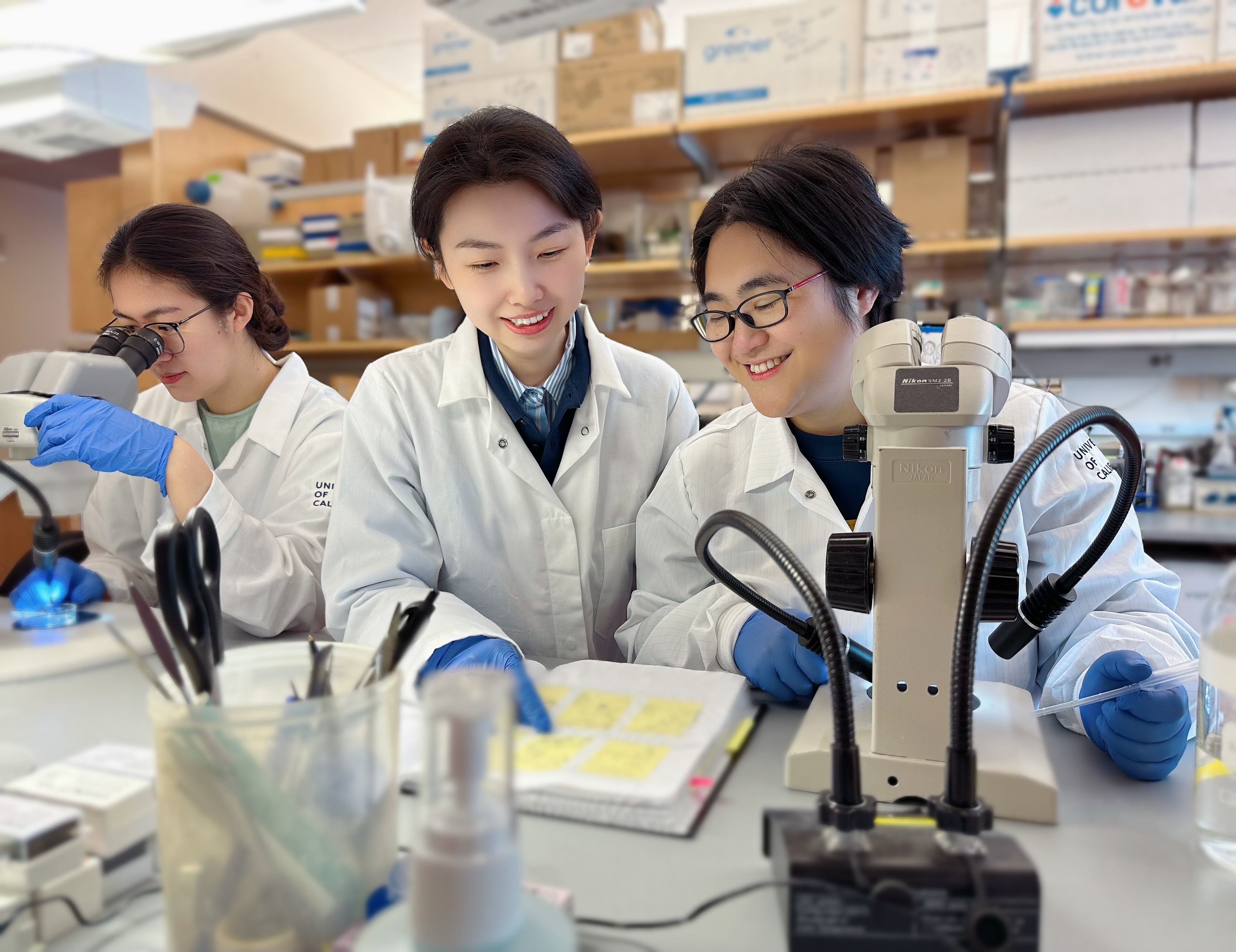
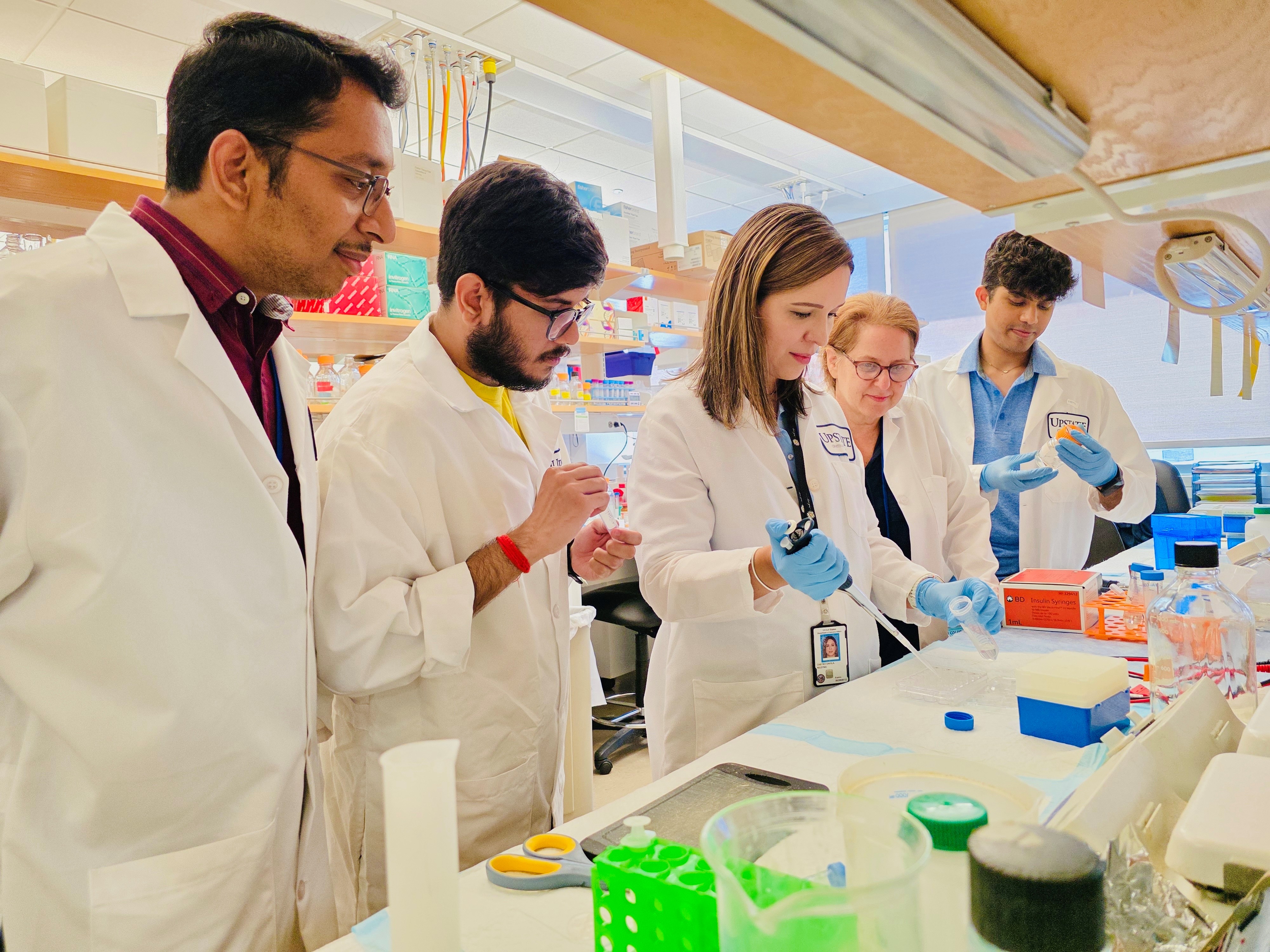
Dr. Zhao and her labmates at the University of California, San Francisco
The particularity of Dr. Zhao’s project is that she aims to study cell resistance to glaucoma by examining, simultaneously, the genes expressed and the cellular location. For that, she had to create models that had never been used before.
As an example, she uses a powerful imaging technique called MERFISH (standing for Multiplexed Error-Robust Fluorescence In Situ Hybridization) in combination with a glaucoma laboratory model. This allows scientists to tune into the “radio stations” of gene expression in specific retinal ganglion cell types, revealing which signals (genes) get turned up or down as the cells interact with their environment (other cells) over time. “That spatial context is incredibly important in a layered structure like the retina, where neighboring cells influence each other,” said Dr. Zhao.
She believes that this detailed, cell-by-cell view could help us better understand what goes wrong in glaucoma and open a door to better understanding how to stop it.
Finding Resilience Signatures to Develop Novel Therapies
Building on her goal to uncover how certain retinal ganglion cells resist damage, Dr. Zhao is now focused on identifying the specific neuronal signatures that support their survival in glaucoma. “Understanding these resilience mechanisms could lead to gene therapy or pharmacologic strategies that prevent or slow down vision loss in glaucoma,” she said.
She added that the BrightFocus support has been incredibly important. The National Glaucoma Research grant she received has allowed her to pursue bold, innovative projects at the intersection of neuroscience, genomics, and ophthalmology. “Thanks to this support, I’ve been able to take the first steps toward independent research, develop novel tools, and generate foundational data that I hope will lead to future therapies,” she added.
According to Dr. Zhao, next plans in the lab involve expanding these studies into human tissues and eventually translating their discoveries into treatment strategies for people with glaucoma.
A Message from Dr. Zhao
Hi, I’m Mengya Chao, a postdoc in the department of ophthalmology at the University of California, San Francisco. I’m really excited and honored to receive the postdoc fellowship in National Glaucoma Research from BrightFocus Foundation. I want to express my deepest gratitude to the donors of BrightFocus. Your generous support is so important. It helps researchers like me to explore new treatments and better understand glaucoma. Your contributions are making a big difference, bringing us closer to the better treatment or hopefully, a cure for glaucoma. Thank you for believing in the power of research and for supporting our work. Together, we are making a real difference for people with glaucoma. Thank you.
National Glaucoma Research is proud to be funding over $7.5 million in groundbreaking glaucoma research globally—made possible by donors like you. Together, we’re advancing toward a future free of this vision-stealing disease. Support our work.
About BrightFocus Foundation
BrightFocus Foundation is a premier global nonprofit funder of research to defeat Alzheimer’s, macular degeneration, and glaucoma. Since its inception more than 50 years ago, BrightFocus and its flagship research programs—Alzheimer’s Disease Research, Macular Degeneration Research, and National Glaucoma Research—has awarded more than $300 million in research grants to scientists around the world, catalyzing thousands of scientific breakthroughs, life-enhancing treatments, and diagnostic tools. We also share the latest research findings, expert information, and resources to empower the millions impacted by these devastating diseases. Learn more at brightfocus.org.
Disclaimer: The information provided here is a public service of BrightFocus Foundation and is not intended to constitute medical advice. Please consult your physician for personalized medical, dietary, and/or exercise advice. Any medications or supplements should only be taken under medical supervision. BrightFocus Foundation does not endorse any medical products or therapies.
Protecting Vision: A New Approach to Scar-Free Healing From Glaucoma Surgery
BrightFocus National Glaucoma Research-funded scientist Jennifer Fan Gaskin, MD, is exploring safer, more effective treatments to prevent scarring after glaucoma filtration surgery, also known as trabeculectomy.
Article
National Glaucoma Research Grantee Receives $2.2 Million Follow-On Award Aimed at Curing Blindness
Additional funding is propelling BrightFocus-funded scientist Jason Meyer, PhD, toward advances in whole-eye transplantation.
Article
Harnessing Artificial Intelligence to Transform Glaucoma Detection
A National Glaucoma Research-funded scientist is pioneering the use of artificial intelligence and telemedicine to detect glaucoma earlier, improve access to care, and prevent irreversible blindness.
Article
A Key Model to Study Cellular Functions to Better Treat Glaucoma
BrightFocus National Glaucoma Research-funded scientist Samuel Herberg, PhD, is using a 3D model of the fluid drainage tissue that could improve our ability to understand and treat glaucoma.
Article
How the Breakdown of Cellular ‘Powerhouses’ Drives Exfoliation Glaucoma
A study yields new insights that could inspire novel treatments for exfoliation glaucoma.
Article
Looking Beyond Pressure-Lowering Drugs to Treat Glaucoma
A National Glaucoma Research-funded scientist is building a 3D model of the optic nerve that she hopes will solve unanswered questions about glaucoma—and inspire new treatments.
Your support helps fund critical research that could prevent vision loss, provide valuable information to the public, and cure this sight-stealing disease.