


Published:
Alzheimer's Disease Research
14 Lifestyle Changes That Could Reduce Your Dementia Risk
Learn about ways you can mitigate your dementia risk starting at any age.
Learn about ways you can mitigate your dementia risk starting at any age.

As many as 45 percent of dementia cases worldwide could be prevented or delayed by addressing 14 modifiable risk factors throughout life, according to the 2024 Lancet Standing Commission on Dementia Prevention, Intervention, and Care1. This international group of leading dementia researchers also added two new risk factors—untreated vision loss and high LDL cholesterol—to its evidence-based framework.
Modifiable risk factors are behaviors, physiological states, and exposures that significantly influence the likelihood of developing chronic illnesses. These findings suggest that dementia risk is influenced by factors ranging from education in early life to hearing loss, decreased physical activity, and social isolation in later years. For the millions of families affected by Alzheimer’s disease and related dementias, the report offers concrete, research-backed steps that could help reduce dementia risk at any age.
“The consideration of the risk factors for dementia using a life course perspective is also particularly valuable—as this suggests that it is never too early in life or too late in life to reduce risk for dementia,” said Quincy Samus, PhD, Lancet Commission member and BrightFocus Foundation Alzheimer’s Disease Research grantee.
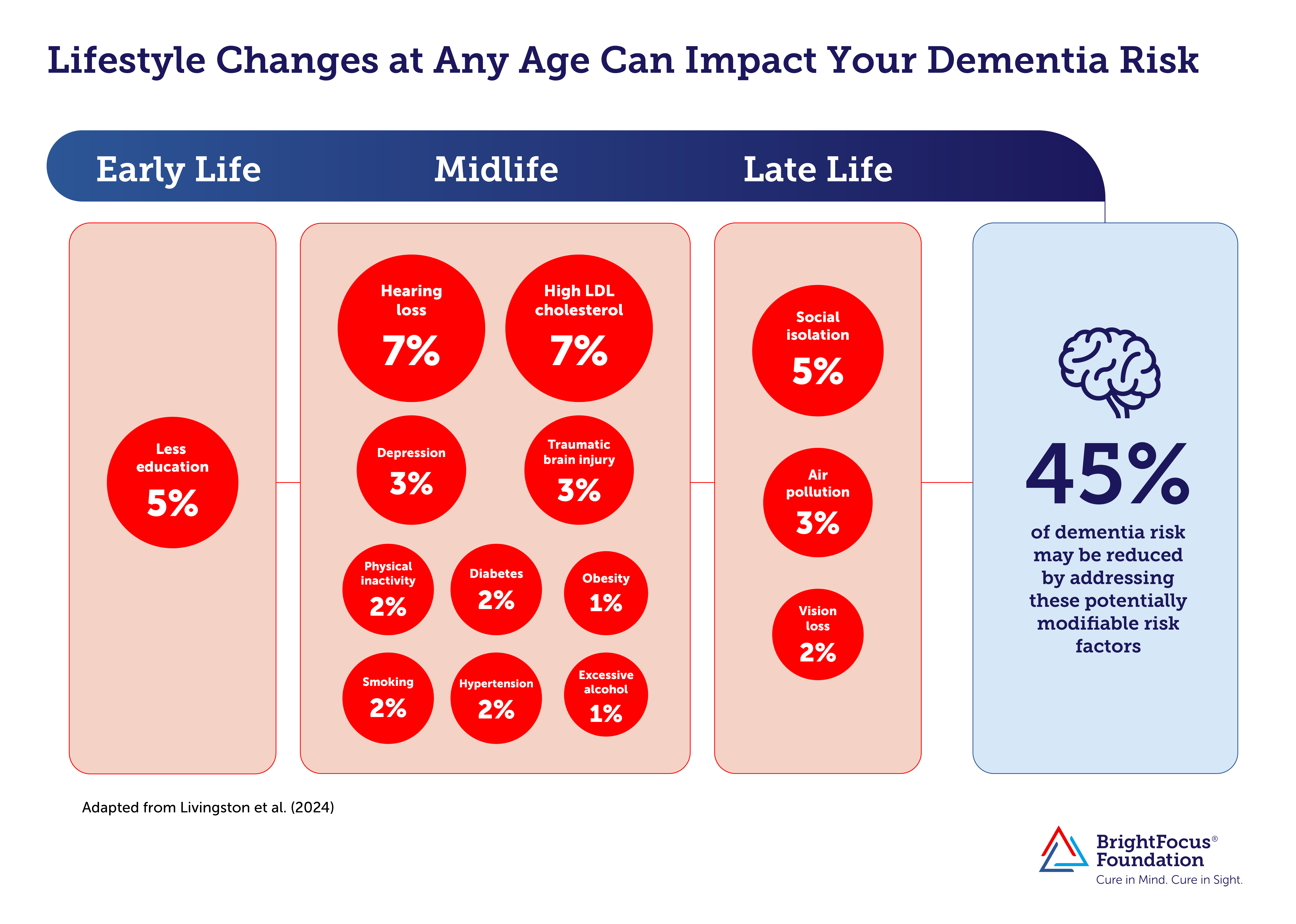
Taking action at any age can provide benefits and reduce dementia risk. Someone who starts walking regularly at 70, gets their hearing checked at 75, or finally schedules that overdue eye exam is still likely to see meaningful benefits in their cognitive health. This holds true even for people with a family history of Alzheimer’s disease or have genetic risk factors. You have the opportunity to reduce the likelihood of developing dementia throughout life, regardless of decisions made decades ago.
| Early Life | Midlife | Late Life | |
|---|---|---|---|
| Less Education (5%) | Hearing Loss (7%) | High LDL Cholesterol (7%) | Social Isolation (5%) |
| Depression (3%) | Traumatic Brain Injury (3%) | Air Pollution (3%) | |
| Physical Inactivity (2%) | Diabetes (2%) | Vision Loss (2%) | |
| Smoking (2%) | Hypertension (2%) | ||
| Diabetes (1%) | Excessive Alcohol (1%) | ||
Among the 14 modifiable risk factors named in the report, two stand out for how easily they can be overlooked, despite being conditions that can be directly addressed.
Hearing loss is among the single-most significant modifiable risk factors for dementia. This may come as a surprise, since hearing loss is often thought of as an inevitable part of aging rather than something connected to brain health. Roughly one in five people worldwide is affected by hearing loss, and most go untreated2.
This matters for brain health because when hearing diminishes, the brain must work harder to process sounds, requiring more effort to carry on conversations and interact with the world. Many people gradually withdraw from social situations when the effort to keep up becomes difficult, and this reduced mental and social stimulation can accelerate cognitive decline. The good news is that hearing aid use can significantly reduce this risk. One major clinical trial3 found that treating hearing loss among people at high risk for dementia with hearing aids for three years reduced cognitive decline by nearly half versus those who didn’t have hearing aids.
Vision loss, a newly identified risk factor in the 2024 report, tells a similar story. This study’s meta-analysis (consensus results from many studies) showed that people with untreated vision impairment had a 47 percent greater risk of developing dementia compared to people with normal vision.
Researchers believe that vision loss affects the brain in a similar fashion to hearing loss: by reducing a person’s engagement with their environment and the people around them. And as with hearing loss, the good news is that vision loss can be treatable. In fact, an estimated 90 percent of cases of adults 65 years of age or older with cataracts can be improved with procedures such as cataract surgery, which was associated with significantly decreased dementia risk4.
Together, treating hearing and vision loss are among the most practical opportunities available today to reduce your risk for dementia.
Research continues to show that brain health does not exist in isolation. One of the clearest examples of this is the finding that high levels of LDL (“bad”) cholesterol are a significant, modifiable dementia risk factor.
High LDL cholesterol levels have been linked to increased risk for heart attack and stroke for decades. What’s new is the strength of the evidence linking it specifically to dementia, particularly when LDL levels are high during midlife (40s and 50s).
By combining data from more than 1.8 million people, the commission found that as LDL cholesterol levels rose, so did dementia risk. Among all 14 risk factors described in the report, LDL cholesterol level was second only to hearing loss in terms of overall impact on dementia risk.
It’s possible that this is a direct biological connection, as excess cholesterol appears to contribute to the buildup of amyloid plaques in the brain, a defining feature of Alzheimer’s disease. A routine cholesterol check followed by treatment or changes in diet to bring levels down, if needed, can have a double impact, helping to reduce your risks for both heart disease and dementia.
These findings offer some clear starting points when it comes to managing your risk for dementia. Scheduling a hearing test, an eye exam, or a cholesterol check might seem like a small step, but mounting evidence suggests that they can be powerful tools for protecting your brain beginning at any age.
Explore BrightFocus Foundation’s free educational resources for brain health.
BrightFocus Foundation is a premier global nonprofit funder of research to defeat Alzheimer’s, macular degeneration, and glaucoma. Since its inception more than 50 years ago, BrightFocus and its flagship research programs—Alzheimer’s Disease Research, Macular Degeneration Research, and National Glaucoma Research—has awarded more than $330 million in research grants to scientists around the world, catalyzing thousands of scientific breakthroughs, life-enhancing treatments, and diagnostic tools. We also share the latest research findings, expert information, and resources to empower the millions impacted by these devastating diseases. Learn more at brightfocus.org.
Disclaimer: The information provided here is a public service of BrightFocus Foundation and is not intended to constitute medical advice. Please consult your physician for personalized medical, dietary, and/or exercise advice. Any medications or supplements should only be taken under medical supervision. BrightFocus Foundation does not endorse any medical products or therapies.
Every Donation is a Step Forward in the Fight Against Alzheimer’s
Your donation powers cutting-edge research and helps scientists explore new treatments. Help bring us closer to a cure and provide valuable information to the public.
Donate Today