Download PDF
SARAH DISANDRO: Hello, and welcome. My name is Sarah DiSandro, and on behalf of BrightFocus Foundation, I’m pleased to be here with you today. November is National Family Caregivers Month, and in honor of that, today’s Macular Chat is titled, “Supporting the Supporters: Care Partners in Vision Loss.”
Macular Chats are a monthly program supported in part by sponsorships from Astellas, Genentech, and Regeneron, designed to provide people living with macular degeneration and the family and friends who support them with information straight from the experts. The information provided in this program is for educational purposes only and should not be considered medical advice. Always consult a qualified health care professional regarding any medical concerns or conditions. And please note that BrightFocus does not endorse or promote any specific brand or product.
BrightFocus Foundation’s Macular Degeneration Research Program has supported over $56 million in scientific grants exploring the root causes and potential prevention, treatment, and cure of macular degeneration and is currently investing in 44 active projects across the globe.
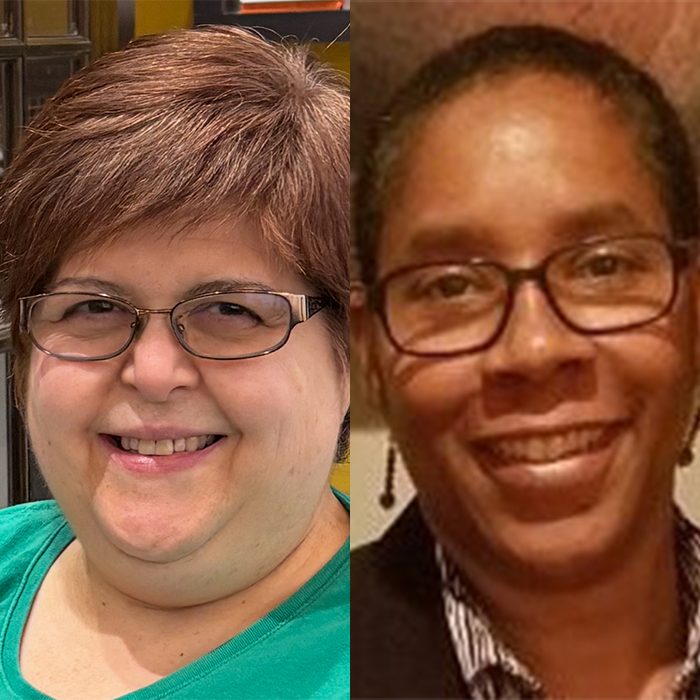
As I mentioned at the beginning, November is National Family Caregivers Month. And when it comes to macular degeneration, the level of support needed may vary from person to person. We’ve also heard many terms when referring to those who provide care and support, including caregiver, care partner, and sighted partner. Today, we’ll hear from two people who support individuals living with age-related macular degeneration. Ellen Ladau is a disability rights advocate. She founded the Larsen Syndrome Resource Center, a hub for people who share her diagnosis. She draws from a deep well of lived experience, both as a person with a disability and a caregiver for people with multiple disabilities, including her mother, who has geographic atrophy. Robin Saunders has been a personal assistant for the past 15 years and currently works with multiple individuals with low vision, including macular degeneration. She’s also an urban farmer who appreciates food as medicine, cooking for her family and friends with freshly grown vegetables and herbs. Thanks for joining us today, Ellen and Robin.
ROBIN SAUNDERS: Thank you.
ELLEN LADAU: Thank you. It’s a pleasure to join you.
SARAH DISANDRO: So, our first question today will be for Ellen: So, Ellen, can you please start us off by sharing a bit about your role and experience as a caregiver to somebody with vision loss, specifically for macular degeneration or geographic atrophy?
ELLEN LADAU: I think that’s a great starting off question, and the way I’ll answer it is first to just briefly explain what Larsen syndrome is. It’s a genetic condition that primarily involves orthopedic disabilities—or abnormalities, I should say—but it can vary from person to person. In my family’s case, because my younger brother and my daughter are also affected, we have hearing difficulties, and I was born with cleft palate. So, Larsen syndrome varies from person to person, and I think that that point is relevant when discussing care with somebody with macular degeneration and geographic atrophy. It’s my mom who has geographic atrophy. I also just quickly want to mention that last month she did move to Florida into an assisted living facility. I’m in New Jersey, and she just didn’t want to go through another cold northeast winter—who can blame her? But going back to my point about Larsen syndrome and how it can vary among people affected by it, I think it’s important to realize that caring for somebody with macular degeneration or GA also can vary from person to person, depending upon if they have other disabling conditions. In my mom’s case, she’s 88. Sorry I shared that, Mom. But she also has hearing difficulties and ambulation difficulties. She is walking with a walker. So, there really isn’t a necessarily typical experience because you have to consider the whole person and what they’re dealing with.
SARAH DISANDRO: I love that. It’s so important to really consider the whole person. And really, yes, each person’s experience is truly unique. Okay. So, our next question here is for Robin: Robin, what can you share with us about your role and experience as a care partner to somebody with vision loss?
ROBIN SAUNDERS: I agree with Ellen. Every individual and their situation is absolutely different and varied and can be similar also in certain ways, certain aspects. I personally assist three different clients, and they all have various levels of sight loss caused by different diseases, one of which is AMD. One client has AMD. But dealing with clients with any vision issue was new to me. I am still a personal assistant, but I have all types of different clients. For instance, I work with clients who have pets, I work with clients who have families, but it doesn’t necessarily have to do with any impairments or any disabilities and such. These were the first three clients with any type of physical challenges. Vision loss for me personally was something new to deal with. So as my clients were learning about their own personal situation, I also put myself into a learning mode, which I guess, technically, I always am in anyhow. But I started going to the classes that they were going to, I was sitting in on the classes as well, but I was taking in information as somebody who’s assisting somebody with those disabilities or those limitations.
So, I was learning and I still am learning every day. And then I came to appreciate how we all have various senses, our senses, whether they’re fully active or not, but how we take for granted what we have. So, it made me open up my own senses to how to deal with somebody who may be missing one or two or three of their own senses. And simple things, just like learning how to walk through a doorway—we all have done it, but when you lose sight, you have to … or if you’re helping somebody who has lost sight, you have to figure out how to explain that to them or how to do or manage any type of almost daily activities that, again, we take for granted. So, it really, I can say, opened up my own eyes to what other people are going through. And so, what I learned and has helped me is how I would want somebody to help me if I was in those situations of some type of impairment or loss.
SARAH DISANDRO: Oh, thank you. That is such good advice,so very true. Robin, our next question is for you, as well: What inspired you to get involved in this field? Was it a personal connection, a professional path, maybe a volunteer opportunity?
ROBIN SAUNDERS: Yeah. I guess it was … well, I’ve been a personal assistant for many years. I’ve been doing that professionally. I’m insured. I’m bonded. I’m a registered business in the city of Austin. I have references, different clients. So, a friend of mine had asked me to help out with his mother-in-law who had lost vision. So, it wasn’t like I was looking for clients that had some kind of visual disability or limitation. I had various clients, doing different things like shopping for clients or bringing people’s laundry, doing their laundry. I had very peculiar clients. One client, I only brought their UGG boots to the dry cleaners twice a year—that’s all I did for them. I had a client one time who worked many hours, so that person couldn’t pick up their CSA package. So in the summertime, I would just go pick up their CSA and bring it to their house, put it in their fridge—that’s all I did for them. So, different clients do different things, but how I came across vision clients, again, it was just part of what I was doing, and my friend called me and said, “Do you still help people out with different things?” And I was like, “Yeah.” He’s like, “Well, my mom-in-law lost her vision, and we really need backup for bringing her to doctor’s appointments.” And I was like, “Yeah, I can do that.” And that was how I started learning about helping people with vision loss. And I would bring her to her doctor’s appointments, and then to her vision support groups. And at those vision support groups is where I met the two other clients who then asked me to help them.
SARAH DISANDRO: Oh,that’s wonderful. Thank you. All right, Ellen, this next question is for you: What does a day look like for you as a care partner?
ELLEN LADAU: Well, when mom was living with me, it was really just assisting with the activities of daily living that we all do: filling up a 7-day pill organizer, which I do for myself; meal prep, which I would be doing for myself and my husband, as well; laundry. The one thing I would help her go through her mail and read things as needed, as well as helping her deal with the computer. Technology, particularly iPhones and other nontactile technology—by that I mean not buttons that you can easily feel—were definitely a challenge for my mom. So, like I said, just basic activities of daily living. And me and my husband taking her to doctor’s appointments. And occasionally, I was her fashion coordinator because sometimes she wouldn’t put on the best color-matching clothing because her GA also affected her color perception, and so I would just tell her, “Hey, Mom, that shirt doesn’t match those pants,” or whatever. And other things like just if she needed something in a store, just paying so it would make life easier, less financial stuff that she has to deal with. So, that would be what a typical day was like.
SARAH DISANDRO: That’s great. That’s great. I love how you were also her fashion coordinator, as well. That’s really helpful. All right, Robin, this next question is for you: What does a typical day look like for you? Can you also talk about your role in maintaining a regular appointment schedule for your clients, such as what you were talking about earlier, transportation to appointments?
ROBIN SAUNDERS: Sure. So,there’s no typical day. Every day is different. Although, for the vision clients, usually it might be 1 day a week I work with the client with AMD, and it could be going to doctor’s appointments, medication, filling the pill box for the week. Medications, I usually do 3 weeks or so in advance. Could be opening mail, managing finances, paying bills, advocating at doctor’s appointments or at least reminding to ask certain questions to doctors when we’re at doctor’s appointments, and also transportation and accompanying to doctor’s appointments or various appointments. And it could be hair appointments, pedicure appointments, chiropractic, dental, medical, any kind of personal care appointments. Shopping, going to the pharmacies, food shopping, hardware store.
I guess for me, the things that I’d learned when I was in the corporate world, when I worked as a corporate assistant—I was an assistant to directors and managers—I guess this … actually, not “I guess,” all of the same things that I utilized, learned in the corporate world, is still transferable and used daily as I work for myself and with clients because you have to use the same skills and protocols with them, such as professionalism, respect for them as clients, respect for their privacy, confidentiality, giving an ear when they need to talk or being a listening ear, and also to give advice when asked for it but not to give it if not asked for it. All of those things, helping with paperwork, helping them pay bills, going through tax papers, tax work, that type of thing. So, it’s a typical day, but not every day is the same.
SARAH DISANDRO: Wow,that’s incredible. There are just so many different things that you’re able to help your clients with. So many of our constituents will contact us talking about their needs, their concerns around driving and transportation. So, it’s just really great to hear you talk about all the various things that you do. And I love your approach—professionalism, respect, confidentiality. Those things are so, so important. All right, Ellen, this next question is for you: Are there specific tasks or routines that have become particularly challenging or rewarding over time?
ELLEN LADAU: Well, before I answer that question, I just want to say how thorough Robin’s answer was to your previous question and just point out that I think all of us at some time or another have been in a caregiver role, be it a parent or even in a career, such as if you’re a teacher, for example, caring for the needs of your kids in your classroom. So, we all bring whatever skills and approaches that we have taken in those roles to caring for the person in our life who has vision loss. And you know what they say: Unfortunately, our parents,as they get older, become our children. And I know that may be tough for some people to hear, but in a lot of ways, there’s been a lot of role reversal. So, being respectful of feelings is particularly important.
But in terms of your question, I think the most challenging thing for me now, especially since my mom no longer lives with me—and I point that out because even though she’s not living in my home right now, I still consider her as somebody I’m a caregiver for—I split responsibilities with my two brothers. We’ve tried to divvy up the main responsibilities to assist her so that there’s not duplication of effort. But for me, first of all, I’m not as technologically experienced as my brothers are, and so much of today is computer-based—email, text, and so on—and I almost think it’s ironic because I’m trying to help my mother from New Jersey, and she’s in Florida. It’s almost like I feel that I’m visually restricted. So trying to help her when I can’t necessarily see what she’s looking at, it’s almost like we’re in the same boat. And it can be a little frustrating to help. Yeah, other than that, we just muddle through the best we can.
SARAH DISANDRO: Okay. Great. And Robin, same question for you: Are there certain tasks or routines that have become particularly challenging or rewarding over time for you?
ROBIN SAUNDERS: Yeah. Ellen just made me think of something when she was just talking.At first, I was going to say not too many challenges. I haven’t really thought of too many challenges, but something that you just said made me think of one, and this is, like, the technology world: the iPhone versus the Android. There’s always that battle. So, two of my clients use iPhones. I am an Android user. And if you know anything about the two of us, there’s the thing where Android users, we are staunch Android users. We do not want to cross over to the iPhone. So, I had to learn about iPhones, and it’s still very confusing to me. So, that is my challenge of helping one of my clients who, again, is totally no vision. So, helping her learn her technology on an iPhone, I then had to learn it in order to assist her with it. Didn’t want to do it. Trust me, I didn’t want anything to do with iPhones, but I did want to help her. I definitely wanted her to have a better quality of life, so I had to change my mindset and let the iPhone life come into my life, so that’s the one thing. It’s a little giggle.
ELLEN LADAU: It’s so funny.
ROBIN SAUNDERS: Yeah.
ELLEN LADAU: No, it is funny, Robin. My family, we have a text thread,and we’re dealing with that issue now. One person in the text thread has Android, and everybody else has iPhone and my mom actually can’t read what’s on the family text because she can’t see it on her iPhone and it doesn’t show up on her computer. And we’re actually trying to figure that out now.
ROBIN SAUNDERS: Yeah,it’s a major—
ELLEN LADAU: Yeah,it’s a major issue. I mean, even though technology is supposed to help overall in our lives for people with vision impairments, it actually is more challenging, especially if they’re older adults and they didn’t grow up with all this technology, so it’s harder for them to learn it, even if they’re sighted. So, yeah, I see we both share that same issue.
ROBIN SAUNDERS: Absolutely. And then I think,yeah, that just makes me laugh because it is, it’s an ongoing thing. And like you said, technology is supposed to help everyone, but in order to use it, you spend so much time trying to learn the technology, and then they’re changing the versions every few months. So then, especially with vision loss, it can be very frustrating that they totally change everything instead of just fixing whatever the one problem was. The next version comes out, and everything’s changed, and you have to relearn … the person has to relearn it. And I just … technology. I don’t want to talk about it right now.
But some of the rewards … oh my God. Some of the rewards with working with my clients with vision loss is they hire me to help them with their lives, but I mean, I feel having them as a client, all of them have become more than just a client, honestly. We have relationships where we’re friends—more than friends. They’re all my mom’s age, my parents’ age, so they’re also full of wisdom for me. And I get so much inspiration hearing their stories, learning from their past professional lives, how they deal with life. Many things that come up in life have helped me and prepared me for things that I’m living through in my own personal life. So, I guess some of the challenges and rewards are we’re all individuals, so having them as a client has also helped me in my own personal life where they’ve been giving me, they’ve offered tips and advice. I’ve gone through … my stepmom died about 4 years ago, and I’m now one of my father’s caretakers. He has dementia. So, they’ve helped me with learning, navigating, understanding, learning again. I’ve also gone through my own personal loss. I had been with my husband for 37, 38 years, and last fall he was diagnosed with stage 4 lung cancer in the summer, and then 7 weeks later he died. So, he died in October last year. All my clients have been through losses, whether of husbands or older family members, loved ones, and they’ve helped me through my own personal situations. So, I see and I feel working with them is both challenging and very much more rewarding.
SARAH DISANDRO: Oh,yeah. I’m so sorry for your loss. And yeah, I think it is incredibly rewarding and inspiring to work closely with people who are going through these things in their lives. Absolutely.
ROBIN SAUNDERS: Thank you.Yeah.
SARAH DISANDRO: All right.Next question is for Ellen: Ellen, how do you manage caregiver stress or burnout? And what advice would you give to others in similar roles? And also, what kinds of support—emotional, practical, or educational—have made the biggest difference for you?
ELLEN LADAU: Okay.Well, I just, if I may, I just want to add one point to what Robin said. I’m also very sorry for your loss, Robin. I just wanted to say that, for me, it’s just also been very hard to see somebody that I love struggle so much. And one other point that I want to mention is that macular degeneration is partly hereditary. So, emotionally, it’s difficult for me to see what could be in my future or people in my family’s future. And I just want to thank BrightFocus. Organizations such as yours are so critical to fund research to hopefully find ways to prevent AMD and GA or to have better treatments to slow down or prevent vision loss.
Regarding your question about caregiver burnout, I wouldn’t say that I have burnout, per se. It’s more just that I have my own disabilities, as mentioned at the top of the show. I have issues with chronic pain and fatigue. I’ve just learned while mom was living with me, or even in dealing with my husband or just my general life, to just pace myself. And I try to schedule things to do earlier in the day when I have more energy. And mom learned that unless it was really important that after dinner was my time to relax. If it was something that could wait, we would wait till the next day when I felt a little bit more refreshed. So, it’s just … caregivers … and it’s said so often, caregivers, in order to be a better caregiver to someone else, you have to first take care of yourself. And you, therefore, need to try to recognize what your needs are in order to have the energy and emotional endurance to help, be it a client, as in Robin’s case, or a relative, such as my mom in my case.
SARAH DISANDRO: Absolutely. Thank you for that. Robin, this next question is for you: Are there any programs, tools, or organizations you found especially helpful for care partners or people with vision loss?
ROBIN SAUNDERS: Yeah, definitely.I’m in Boston. We’re in Massachusetts. So, here, there’s the Massachusetts Commission for the Blind. There’s the MABVI, the Massachusetts Association for the Blind and Visually Impaired. And they have technology support, and they have different groups. And then, whatever city you live in—so, for the city of Boston, they have senior centers or senior groups or the Council for the Aged, or if you’re working with a vision person who’s younger, a juvenile or a child, they have different support groups depending on what age. But yeah, definitely tap into Massachusetts Commission for the Blind and also MABVI. And then just learning about … so, this is the first year I’ve heard about the National Family Caregivers Month, because of you, because of this organization. So, I looked that up, as well, and they have a caregiver site. They have a website and some services for caregivers, as well. So, definitely look into whatever your city, state, or different religious groups have to offer, as well. Yeah.
SARAH DISANDRO: That’s great advice, and those are some really great resources.Ellen, are there any additional programs, tools, or organizations you’d like to mention?
ELLEN LADAU: Not particularly any thatI’m aware of, but definitely as soon as mom came up from Florida here to New Jersey, a quick Google search helped me find the New Jersey Commission for the Blind and Visually Impaired. They sent somebody over to assess mom, who interestingly enough was totally blind herself, and they went over what mom’s needs were and what tools may make her life easier. For example, I’d never heard of something called bump dots. They’re little silicone-sealing dots. Almost think of the childhood candy where they had called dots, on that paper. Well, that’s what it looks like. But you pull one of these things off, and you put it on, like, the Start button of the microwave or the toaster oven, so if, obviously, there’s difficulty seeing these buttons, you can feel for them by learning their location or what it’s representing. Another tool, very simple and you can get it in any stationery store, black sharpies. Try to encourage the use of thick, black sharpies—in other words, a thick point—and write everything boldly. If you’re printing anything out on your computer, use a large font and use the bold feature. It just makes it easier for people with GA, who are not totally blind. They have some peripheral vision, and it makes it easier for them to be able to read or do some functions more independently, and that really also should be the goal of a caretaker, is to try to help whoever they’re taking care of do as much as independently as possible but be there to help as needed.
SARAH DISANDRO: That’s great. Both of your responses are incredibly helpful for our community, and I’d also like to say to our listeners today, just to reiterate what Robin was saying earlier, to make sure you are checking for your state resources in your own state, as well. So, each state is going to have different resources available. That’s going to vary state by state, city by city, so definitely checking your local resources will be important, too. All right, our next question. I’m going to kick this one over to Robin first: What do you wish more people understood about the role of care partners in the vision loss community?
ROBIN SAUNDERS: I guess, whether you’re a family member, a paid person likemyself, a community volunteer—essentially, like Ellen said, we’re there to provide assistance, to allow that person to have as much independence as they possibly can have, so it’s like you want to do things for them, but you can’t overly do things for them. And sometimes … and then, again, it depends on that day. That day, they might need you to do more for them than another day. Another day, it might be the day that they need to be allowed not to have to do everything for themselves that day, so once you know the person, you’re there to provide assistance in order for them to have a better quality of life, better quality of living in their situation due to whatever their losses are, whether they’re visuals and additional limitations, as well.
SARAH DISANDRO: All right, thank you. Ellen, same question for you: What do you wish more people understood about the role of care partners in the vision loss community?
ELLEN LADAU: Well, I think,as in any situation where caregiving is involved, it’s just important to understand that it is a 24/7 job. I’m not paid for the job, but I think, just from listening to Robin’s responses, I know that even when she’s not with her clients, that she’s thinking about things. If she sees something out and about in her own day that might benefit a client, she’s going to either share that information or purchase that item. I also want to mention, like I said, it’s 24/7, and even though my mom no longer lives with me and my husband, it’s always a sense of worry. Worry that she’s happy, worry that the people in the facility are giving her the care that she needs. As I stressed to her many times before she moved, “You’re not going to have me 15 feet away from you to come and help you put on Netflix or something. You’re going to have to learn to wait for assistance.” So, because of that, it’s always just a sense of anxiety that will never go away.
SARAH DISANDRO: Okay, great.And Ellen, we just received a listener question for you. So, one of our listeners just asked us: What can I do now to prepare my family that I may need help in the future? So, this is someone with early stage macular degeneration, and this individual wants to know what they can do now to prepare their family, because they recognize they’re going to need some help in the future.
ELLEN LADAU: This may sound like a funny answer, but when I first realized the extent of my mother’s vision loss, I started practicing doing things with my eyes closed, justkind of getting a sense of what can I accomplish using other senses. And in my case, also because I have a hearing disability, I don’t have that as much to depend on. They say when people lose one sense, the other senses become stronger. So, I definitely worried about that, too, and I just tried practicing things. But just also within your own home environment, I think it’s important to do things like declutter, get rid of throw rugs, just spend time now really organizing your stuff—your kitchen, your bedroom—to have things in most optimal places, things that you use the most, the easiest to reach, just everyday practical things that I have to do in my own life just because of my physical disability. So by preparing yourself in advance, you’re going to also help make it easier for your family. So, there’ll be less catch up to figure out how to accomplish tasks.
SARAH DISANDRO: Okay, great. That was a wonderful answer. All right, then our next question is for Robin: Robin, if you could give one piece of advice to someone just beginning their caring journey, what would it be?
ROBIN SAUNDERS: I don’t know how to limit it to one, but I just want to also agree with Ellen, what she just said, because with the question that was asked of her, I also did the same thing. So, I literally … and I still do; it’s not like when I first started having these clients. Try taking a shower with your eyes closed. Try walking from the kitchen to your living room with your eyes closed. Try walking through your front door. Like, I literally did that so that I could understand and feel and sense what my clients were feeling and what they were and were not seeing so that I could better help them or for me to better understand what they were going through. And so, if you have family members or if you sense you’ll be needing more care, as you come across different articles, share them with your family members, especially ones that are talking about caregiving or talking about empathy for those who need care, or articles or you might see or hear things in the news that might help them understand what you’re going through. Share it with them, and be willing to have honest discussions about, “Look, I might need this in a year from now, 2 years from now, 5 years from now, and you might be somebody that I might need to depend on,” because it is a transition, and it’s good if it’s as long of a transition as possible.
Okay, so getting back to your question, one piece of advice, I would say, is to remember while you’re caring for others, in order to do that successfully, you have to care for yourself, as well. So, self-awareness of your own needs; your own doctor’s appointments, dentist appointments; your own social time; getting in your own personal growth, maybe hobbies; exercise, eating healthy—that’s all very important. So, as you take care of yourself, you’ll be in a better position to help to take care of somebody else.
SARAH DISANDRO: That’s great advice. Ellen, do you have anything else you’d like to add?
ELLEN LADAU: I think that one of the things that I try to do, and I’ll admit I’m not always successful, but just always try to imagine or feel the frustration of the person you’re taking care of, the frustration that they feel of losing a critical sense. For example, if you lose hearing, most people can be helped by a hearing aid or cochlear implants these days, but there’s no way that I’m aware of to completely restore somebody’s sight at this point. So, it has to be incredibly frustrating to have this happen to you, and sometimes this happens over a very slow period of time, so there’s more time to adjust, and other times it can happen more quickly, and that makes the adjustment harder. So, by always keeping that in mind, I think it will make you a better caregiver.
SARAH DISANDRO: All right. Thank you so much. Well, Ellen and Robin, thank you for the information you shared with us today. We really appreciate your dedication to helping those in the community with vision loss due to macular degeneration, and you all have been fantastic during today’s Chat. Ellen and Robin, before we close, is there a final message you’d like to share in honor of National Family Caregivers Month?
ELLEN LADAU: I would say just give yourself grace. You’re doing the best you can, and that’s all we can do. Just don’t be too hard on yourself. You are doing the best you can under the circumstances.
ROBIN SAUNDERS: Absolutely. I agree with Ellen. I would say have empathy for yourself and those that you’re giving care to. And like I said, National Family Caregivers Month was new to me, so if you get a chance to look at the website like I am looking, it’s www.CaregiverAction.org.
SARAH DISANDRO: Thank you both for those takeaway messages. This is our last Macular Chat of the year, so our next Macular Chat will be on Wednesday, January 28, 2026. Thank you all again for joining us, and this concludes today’s Macular Chat.
Useful Resources and Key Terms
BrightFocus Foundation: (800) 437-2423 or visit us at www.BrightFocus.org. Available resources include—
Helpful low vision tools or resources mentioned during the Chat include—