Protecting Vision: A New Approach to Scar-Free Healing From Glaucoma Surgery
BrightFocus National Glaucoma Research-funded scientist Jennifer Fan Gaskin, MD, is exploring safer, more effective treatments to prevent scarring after glaucoma filtration surgery, also known as trabeculectomy.
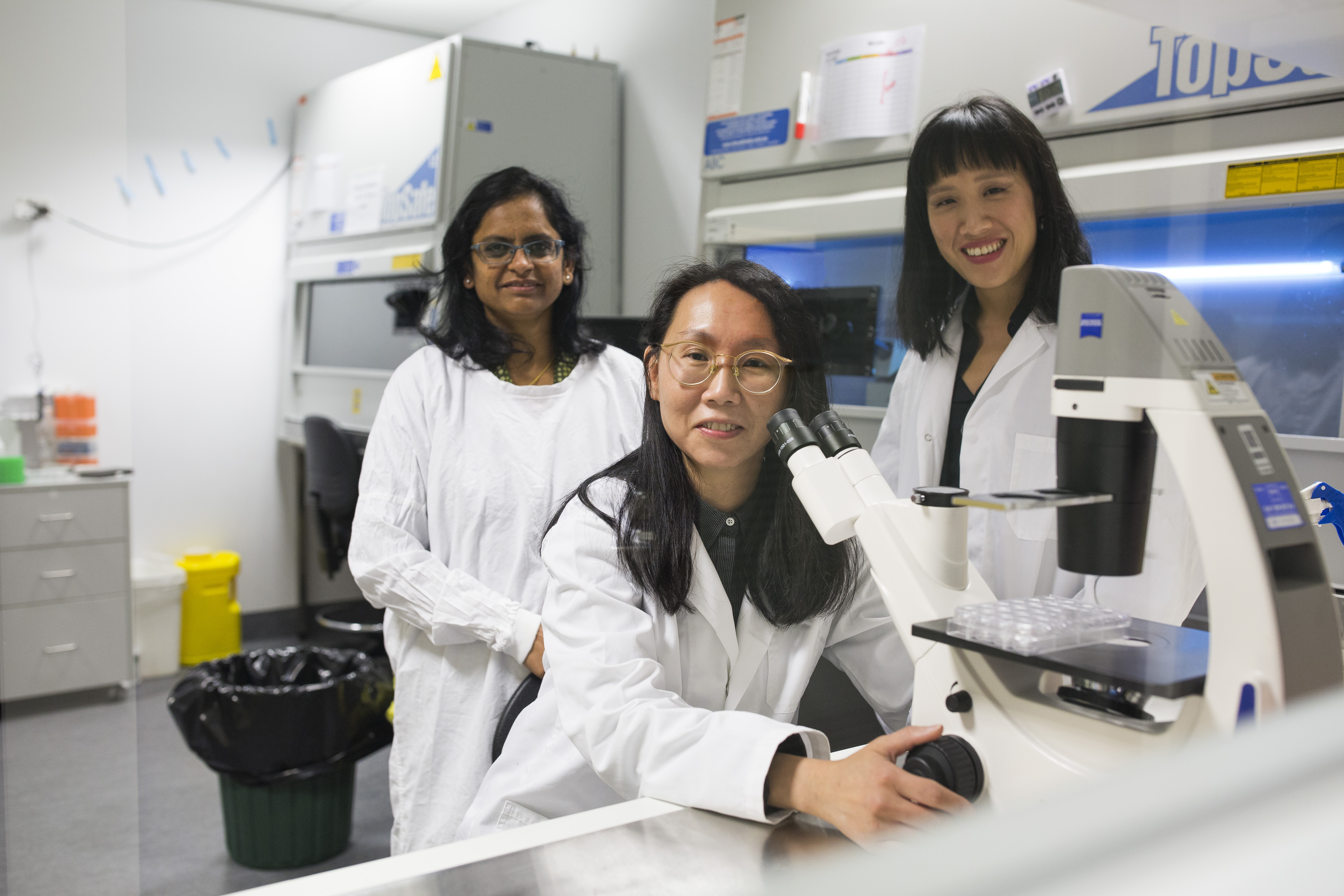
Left to right: Manisha Shah, Elsa Chan, Jennifer Fan Gaskin
Key Takeaways
Up to 50% of glaucoma filtration surgeries fail by 5 years due to scarring, leaving people with glaucoma vulnerable to rising eye pressure and potential blindness.
Jennifer Fan Gaskin, MD, a BrightFocus National Glaucoma Research-funded scientist, is studying new anti-scarring therapies for glaucoma filtration surgery.
She is testing a promising compound, DiOHF, which has shown anti-scarring potential in other diseases.
This study could lead to clinical trial testing within five years.
In advanced glaucoma, when medications and laser therapy are insufficient or unsuitable, physicians opt for glaucoma filtration surgery, also known as trabeculectomy, to slow or prevent further vision loss. Filtration surgery creates a small new pathway to release fluid from the eye, thereby lowering eye pressure. By reducing this pressure, doctors can slow or prevent further damage to the optic nerve.
However, it is the last line of defense due to a major challenge after surgery: the body’s natural healing response. In trying to close the surgical site, the eye can produce scar tissue that blocks the new drainage pathway, allowing pressure to build up again. This scarring remains the leading reason why glaucoma filtration surgeries may fail over time.
Jennifer Fan Gaskin, MD, a BrightFocus Foundation National Glaucoma Research grant recipient, is working to develop safer and more effective therapies that would prevent scarring after glaucoma surgery.
“Despite scarring issues, 60% of glaucoma patients will require surgery during their lifetime, usually only after they have already started to lose vision,” she said. Her grant involves developing and validating a lab model to test anti-scarring compounds that have never been tested in the eye before.
“Our goal is to stop the scarring that can undermine glaucoma surgery and ultimately protect patients from blindness,” said Dr. Fan Gaskin.
When Treatment Falls Short
Today, the most common drugs used to avoid scarring after glaucoma filtration surgery are Mitomycin C and 5-Fluorouracil, two strong anti-cancer medications. Because they are non-specific chemotherapy drugs, they can kill surrounding healthy cells, causing post-surgery problems, Dr. Fan Gaskin explained.
“When the drugs work too well, they can cause long-term wound healing issues such as wound breakdown, wound leak, severe infections, or even loss of the eye,” she added. Because of this, the drugs are typically applied in a low concentration for only a few minutes, and their effect is not sufficient for preventing scar formation.
Dr. Fan Gaskin team is studying the molecule 3′,4′-dihydroxyflavonol (DiOHF) as a safer anti-scarring therapy. DiOHF is a laboratory-made compound inspired by natural plant chemicals. It has both antioxidant properties, which protect cells from damage, and anti-fibrotic properties, which help prevent scar tissue formation. Studies have shown encouraging results in reducing scarring across several experimental models in cardiac disease and certain cancers.
“Our vision is to take this compound to a clinical trial in the next five years.”
As people with glaucoma urgently need new anti-scarring therapies, Dr. Fan Gaskin wants to test DiOHF in the eye. “It has strong antioxidant effects that help to reduce scarring in a unique pathway over and above other agents,” she said.
A Clinician’s Frustration, A Scientist’s Mission
Dr. Fan Gaskin has personally witnessed the devastating effects of glaucoma surgery failure in her patients. “As a clinician-scientist, I am constantly frustrated by the frequent failure of glaucoma filtration surgery due to scarring,” she said.
The surgery is an effective treatment and provides the best way of lowering intraocular pressure among all other treatment options, she added. However, due to the risk of scarring and the associated risk factors with the current forms of anti-scarring therapy, physicians reserve glaucoma filtration surgery as a last resort.
“Up to 50% of glaucoma filtration surgery fails by 5 years due to scarring,” said Dr. Fan Gaskin.
Making matters worse, when glaucoma filtration surgery fails, subsequent operations are more likely to fail as the scarring responses in the eye are already activated, leaving people with limited treatment options and headed for blindness. “With improved wound healing management, this operation could be performed earlier and offered to more patients before any sight has been lost,” she said.
Bringing Hope Closer to the Clinic
Improved wound healing management means that glaucoma filtration surgery could be performed earlier and offered to more people before they lose any sight. With support from BrightFocus’ National Glaucoma Research program, Dr. Fan Gaskin and her team are working toward this goal.
Another challenge is that some people with glaucoma develop far more scarring than others, and the reasons for this remain poorly understood. Dr. Fan Gaskin’s research project also involves genetic studies to discern this. “Exploring the genetic pathways of wound healing will help us tailor treatment to patients individually to target their specific scarring responses,” she said.
Dr. Fan Gaskin’s team already has early-stage lab data on the efficacy of DiOHF in reducing scarring after glaucoma filtration surgery. Now, thanks to donors who made this grant possible, the team plans to take the project to the next step, bringing it closer to clinical trials where the molecule can be tested in people. “The support provided by BrightFocus’ National Glaucoma Research program has been immensely invaluable,” Dr. Fan Gaskin said.
About BrightFocus Foundation
BrightFocus Foundation is a premier global nonprofit funder of research to defeat Alzheimer’s, macular degeneration, and glaucoma. Since its inception more than 50 years ago, BrightFocus and its flagship research programs—Alzheimer’s Disease Research, Macular Degeneration Research, and National Glaucoma Research—has awarded more than $300 million in research grants to scientists around the world, catalyzing thousands of scientific breakthroughs, life-enhancing treatments, and diagnostic tools. We also share the latest research findings, expert information, and resources to empower the millions impacted by these devastating diseases. Learn more at brightfocus.org.
Disclaimer: The information provided here is a public service of BrightFocus Foundation and is not intended to constitute medical advice. Please consult your physician for personalized medical, dietary, and/or exercise advice. Any medications or supplements should only be taken under medical supervision. BrightFocus Foundation does not endorse any medical products or therapies.
National Glaucoma Research Grantee Receives $2.2 Million Follow-On Award Aimed at Curing Blindness
Additional funding is propelling BrightFocus-funded scientist Jason Meyer, PhD, toward advances in whole-eye transplantation.
Article
Harnessing Artificial Intelligence to Transform Glaucoma Detection
A National Glaucoma Research-funded scientist is pioneering the use of artificial intelligence and telemedicine to detect glaucoma earlier, improve access to care, and prevent irreversible blindness.
Article
How Some Eye Cells Survive Glaucoma
BrightFocus National Glaucoma Research-funded scientist Mengya Zhao, PhD, uses a unique combination of techniques to understand why certain retinal cells stay strong in glaucoma while others don’t.
Article
A Key Model to Study Cellular Functions to Better Treat Glaucoma
BrightFocus National Glaucoma Research-funded scientist Samuel Herberg, PhD, is using a 3D model of the fluid drainage tissue that could improve our ability to understand and treat glaucoma.
Article
How the Breakdown of Cellular ‘Powerhouses’ Drives Exfoliation Glaucoma
A study yields new insights that could inspire novel treatments for exfoliation glaucoma.
Article
Looking Beyond Pressure-Lowering Drugs to Treat Glaucoma
A National Glaucoma Research-funded scientist is building a 3D model of the optic nerve that she hopes will solve unanswered questions about glaucoma—and inspire new treatments.
Your support helps fund critical research that could prevent vision loss, provide valuable information to the public, and cure this sight-stealing disease.