A New Macular Degeneration Suspect: The Eye's Light-Sensing Cells
After discovering that photoreceptors actively drive the debris formation seen in age-related macular degeneration, BrightFocus Macular Degeneration Research grantee Claudio Punzo, PhD, helped develop a single-injection gene-silencing therapy designed to reverse this process, opening a new avenue for treatment.
With support from BrightFocus Foundation’s Macular Degeneration Research program, Claudio Punzo, PhD, discovered that disrupted photoreceptors, the eye’s light-sensing cells, play an active role in age-related macular degeneration (AMD).
His team found that aging photoreceptors can mismanage fats in the cell, setting off a chain reaction that leads to harmful waste deposits.
Using a new model built specifically to test this idea, Dr. Punzo’s team developed a gene-silencing treatment that reversed the mismanagement of fats and slowed debris formation in the eye.
Delivered by a single injection, the treatment could someday reduce how often people with AMD need treatment, representing a meaningful quality-of-life improvement.
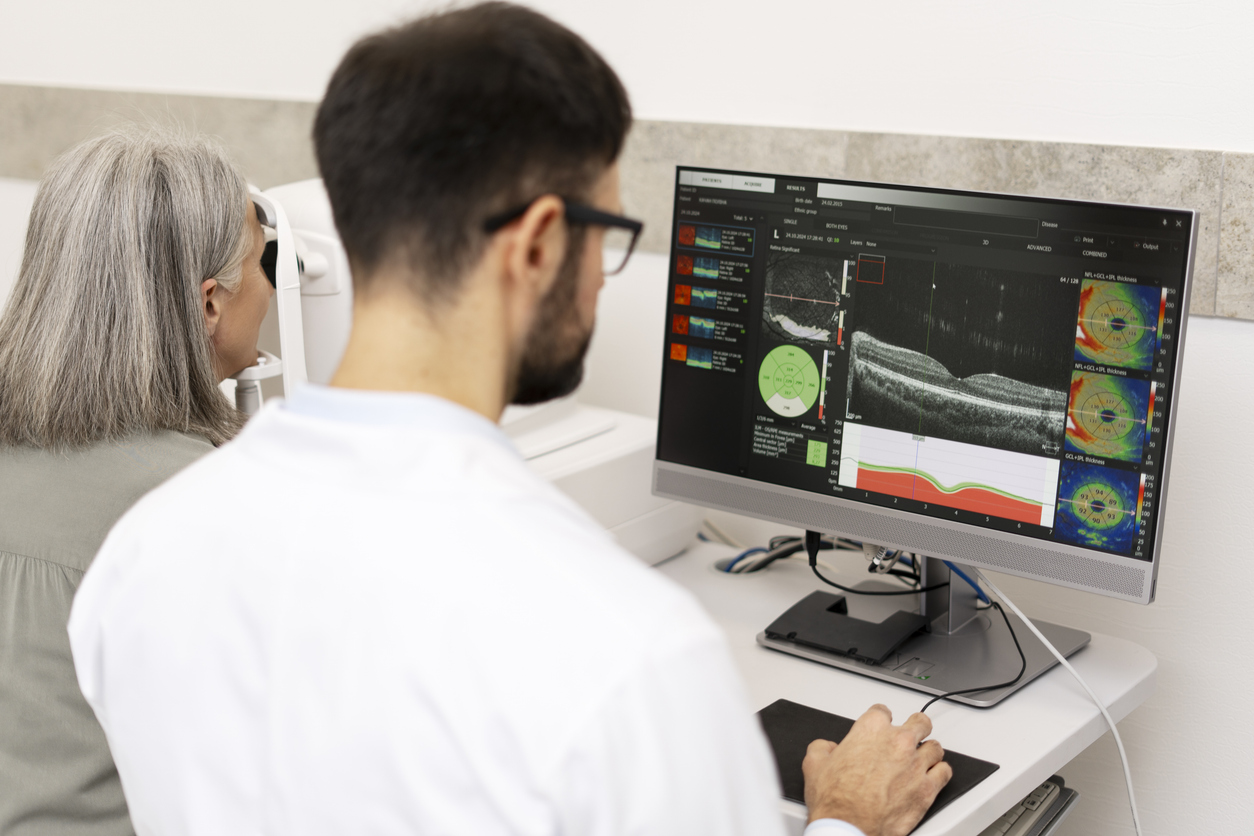
A picture of the macula. New BrightFocus-funded research suggests that metabolic changes in light-sensing cells in this region of the eye could drive age-related macular degeneration.
Inside the retina, a layer of cells called the retinal pigment epithelium (RPE) works around the clock to clear waste from neighboring photoreceptors, the cells that sense light. In people with age-related macular degeneration (AMD), that cleanup system breaks down, and the debris left behind is often blamed on the RPE. Now, a new study published in Molecular Therapy Nucleic Acids led by Macular Degeneration Research grant recipient Claudio Punzo, PhD, points to a different culprit: the photoreceptors themselves1.
Dr. Punzo, associate professor and vice chair for research at the University of Massachusetts Medical School, and his team found that as photoreceptors age, they can mismanage the fats that make up their cell membranes, setting off a chain reaction that leads to toxic debris buildup. Using a new model of AMD, Dr. Punzo’s team has developed a gene-silencing therapy that reversed this process for as long as six months, opening up a potential new way to treat a disease that currently has few good options.
A gut feeling leads to a discovery
The research emerged from a hunch Dr. Punzo had while studying a different type of retinal disease. “It was initially an intuition that was driven in part from lessons I learned about photoreceptors,” he said. That work taught him how photoreceptors respond when they’re deprived of nutrients.
For years, the field has largely treated photoreceptors as innocent casualties of the disease, affected by the RPE deteriorating around them rather than playing an active role in retinal damage. Dr. Punzo suspected otherwise.
Photoreceptors are naturally rich in fats, which they use to hold the proteins essential for vision. As people age, the fat makeup of those cells shifts slightly, which is a normal part of getting older. But in people with AMD, that shift is far more pronounced, and Dr. Punzo’s team suspected it’s this exaggerated change that ultimately overwhelms the RPE’s ability to clear waste.
New models and treatments for AMD
Dr. Punzo in the lab
To test that idea, Dr. Punzo’s lab first needed a better model to study AMD. His team created a new model to mimic the same changes seen in human photoreceptor tissue. This model went on to develop an advanced form of AMD at a similar rate to humans.
With the model in hand, Dr. Punzo’s team developed a gene-silencing therapy delivered by a single injection that dialed down a gene controlling how photoreceptors manage fats. In treated models, the therapy reduced the buildup of fatty deposits at the back of the eye and reversed the early markers of AMD.
If the same single-injection therapy works in people, it could be a gamechanger. Current AMD treatments typically require injections every month or two, limiting their accessibility.
“This is a burden for elderly people and their family members who often have to drive them to the doctor’s appointment, and the injection is not the most comfortable procedure,” Dr. Punzo said. “Any reduction in frequency is a direct improvement in the quality of life of these patients.”
The work’s impact goes beyond this single therapy. By identifying photoreceptors as active drivers of disease, Dr. Punzo’s research could reframe how scientists think about AMD altogether, allowing them to treat the root cause of the disease rather than just its symptoms.
“This is similar to treating a cold with medicine that reduces coughing or sneezing rather than with medicine that destroys the virus directly,” Dr. Punzo said.
From the lab to the clinic
The next step for this research is determining whether the treatment works in people. Alongside university colleagues, Dr. Punzo helped launch a company to carry the work forward. The company’s mission is reflected in its name: Trinetra, after the all-seeing third eye of the Hindu deity Shiva. The next planned milestone is a large-scale preclinical safety trial.
Dr. Punzo’s discovery is one piece of Macular Degeneration Research’s 360-degree approach, with research funding for cell metabolism, debris formation, genetics, and cell regeneration. That range of strategies means that each discovery can play off each other, paving the way for the whole field.
None of his own work would have been possible, Dr. Punzo said, without early support from Macular Degeneration Research.
“With money being tight, we researchers often face the problem of deciding whether to follow some of our instincts and test something new or just go down the safe and established road where continued funding is easier to obtain,” Punzo said. “Without this seed money, many great ideas die in the minds of researchers, and we don’t find out if they were worth pursuing.”
“Every dollar you donate may help someone translate an idea into real data,” Dr. Punzo added, “which hopefully at one point becomes a translatable therapy.”
Help accelerate tomorrow’s breakthroughs. Learn how to support our work and advance macular degeneration research.
BrightFocus Foundation is a premier global nonprofit funder of research to defeat Alzheimer’s, macular degeneration, and glaucoma. Since its inception more than 50 years ago, BrightFocus and its flagship research programs—Alzheimer’s Disease Research, Macular Degeneration Research, and National Glaucoma Research—has awarded more than $330 million in research grants to scientists around the world, catalyzing thousands of scientific breakthroughs, life-enhancing treatments, and diagnostic tools. We also share the latest research findings, expert information, and resources to empower the millions impacted by these devastating diseases. Learn more at brightfocus.org.
Disclaimer: The information provided here is a public service of BrightFocus Foundation and is not intended to constitute medical advice. Please consult your physician for personalized medical, dietary, and/or exercise advice. Any medications or supplements should only be taken under medical supervision. BrightFocus Foundation does not endorse any medical products or therapies.
Lessons from Zebrafish: Restoring "Ground Zero" in Macular Degeneration
BrightFocus Macular Degeneration Research grant recipient Lyndsay Leach, PhD, is investigating what makes another species capable of regrowing the part of the eye where age-related macular degeneration starts.
Article
Shaping the Future of Macular Degeneration Research: Key Takeaways from the 2025 AMD Fast Track Workshop
BrightFocus Foundation’s 2025 Age-Related Macular Degeneration (AMD) Fast Track brought together early-career and established scientists to accelerate research toward a cure for AMD.
Article
How Understanding Lipid Processing in the Eye Could Spark Innovative AMD Treatment Approaches
With the help of funding from Macular Degeneration Research, Dr. Neetu Kushwah is studying the link between abnormal lipid regulation in the eye, inflammation, and age-related macular degeneration. Her findings could inspire new methods for treating the disease.
Article
Early Research Funding Is Essential to Saving Sight From Macular Degeneration
Medicine's biggest breakthroughs often start out as the smallest of ideas. BrightFocus Foundation’s Macular Degeneration Research supports bold, early-stage science across a wide range of approaches.
Article
Macular Degeneration Research News: Fall 2025
In this issue: Light Therapy Is Shining, New Hope on Vision Loss, Can We Turn Back the Clock on Vision Loss? And more!
Article
New Supplement to Prevent Macular Degeneration Inspires Deeper Search for Cures
A Macular Degeneration Research-funded scientist launched a supplement based on a link he discovered between the eye disease and Parkinson’s disease. Now he’s continuing research in the hopes of finding novel cures.