Shaping the Future of Macular Degeneration Research: Key Takeaways from the 2025 AMD Fast Track Workshop
BrightFocus Foundation’s 2025 Age-Related Macular Degeneration (AMD) Fast Track brought together early-career and established scientists to accelerate research toward a cure for AMD.
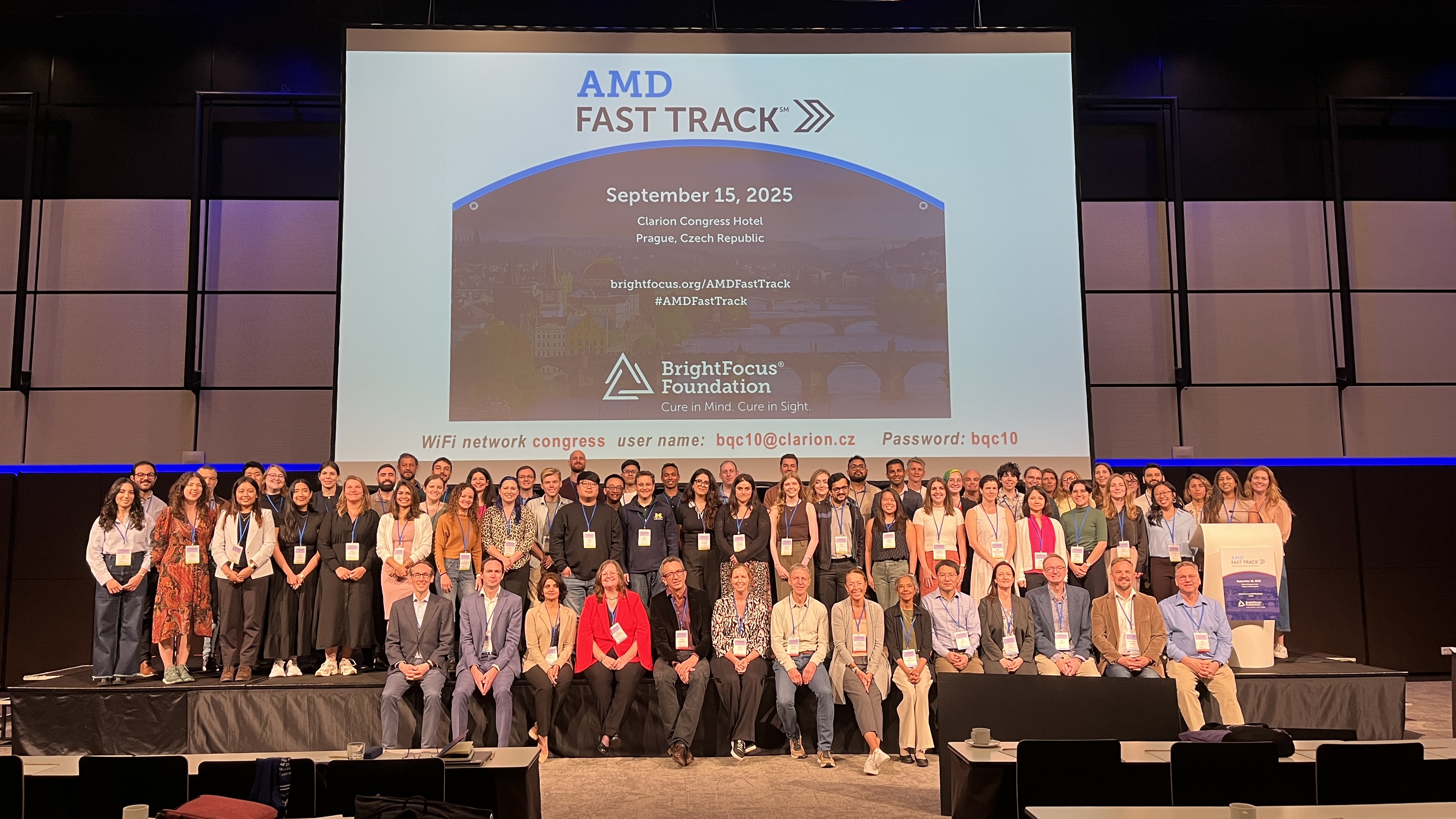
2025 AMD Fast Track participants at the Clarion Congress Hotel, Prague
On September 15, 2025, BrightFocus Foundation presented the 3rd biennial AMD Fast Track workshop in Prague, Czech Republic. It was attended by more than 220 clinicians and researchers from 12 countries with strong representation from graduate students, postdoctoral fellows, and early-career investigators. AMD Fast Track brings together established leaders in the field and early-career scientists, with the goal of promoting mentorship, education, and the exchange of ideas. This year’s workshop was co-chaired by Diane Bovenkamp, PhD; Sarah Doyle, PhD; and Florian Sennlaub, MD, PhD.
During the workshop, attendees were immersed in the latest research discoveries and clinical understanding, while connecting with preeminent vision scientists and early-stage researchers from across the globe.
“BrightFocus was proud to organize and sponsor the third AMD Fast Track, where the topics selected were chosen to help new and established scientists increase their knowledge of AMD and accelerate their research into the causes and treatment of macular degeneration,” said Dr. Bovenkamp, vice president of scientific affairs at BrightFocus. “We were especially proud to hold the AMD Fast Track as a pre-symposium to the 16th International Symposium on Retinal Degeneration (RD2025) Meeting.”
John Ash, PhD, professor at the University of Pittsburgh School of Medicine, RD2025 Organizing Committee member, and a member of the BrightFocus Macular Degeneration Research Scientific Review Committee, emphasized BrightFocus’ commitment to training the next generation of vision researchers: “The purpose of the Fast Track was to actually improve the science and the applications for young investigators submitting grants to BrightFocus Foundation for their investigator funding. We created this Fast Track to give it an educational platform so that young investigators could actually get an advantage and learn what BrightFocus was looking for in terms of their grant application. Those of us on the committee see this as a huge success.”
To date, this signature BrightFocus program has trained 208 early career investigators from 18 countries. At this 2025 meeting, over 50 early-career scientists were able to attend thanks to BrightFocus travel awards.
The workshop featured talks by investigators on the science and clinical management of AMD, identified remaining challenges, and offered a hopeful outlook for the future. Talks addressed the structure and function of the retina, the light-sensing tissue at the back of the eye, and the macula, its central region responsible for sharp, detailed vision.
In AMD, the macula is progressively damaged, making tasks like recognizing faces or reading more and more difficult. AMD progresses slowly, with little vision loss during the early stages, underscoring the importance of early detection and intervention to slow progression and preserve vision.
Four Key Takeaways From AMD Fast Track 2025
Lifestyle and Biology Affect the Risk of Developing AMD
Lifestyle factors play a big role in determining the risk for developing AMD. The No. 1 risk factor by far is smoking, with some estimates suggesting that it increases the risk of AMD almost four-fold. Smokers are often diagnosed up to a decade earlier and experience a more rapid disease progression. Luckily, risk decreases once people stop smoking, and even if AMD has already been diagnosed, smoking cessation can slow its progression.
The Mediterranean-type diet, and especially fish, can reduce AMD risk by over one third.
Tiarnan Keenan, MD, PhD, a researcher at the National Eye Institute, emphasized that healthy food choices can lower AMD risk–especially a Mediterranean-style diet rich in fruits and vegetables, whole grains, nuts, dairy, plant-based oils, eggs and particularly fish, but low in red meat, sugar and processed foods.
Large clinical studies have shown that such a diet can cut AMD risk by more than one third. Better still, the Mediterranean diet has plenty of other health benefits: it is anti-inflammatory, lowers diabetes risk and promotes cardiovascular health. The good news here is that lifestyle modifications are within our power, so we can control some of our AMD risk.
Genetics and ethnicity play a big role in AMD, too. There are numerous genetic risk factors, which vary by population, leading to different rates of AMD, and clinical features of the disease as well, depending on one’s ethnic background.
In her presentation, Usha Chakravarthy, MD, PhD, professor at Queen’s University Belfast, pointed out that a specific form of AMD called polypoidal choroidopathy is most frequently seen in people of Asian descent. People with light-colored eyes may have a greater AMD risk because they have less protective pigment, allowing more harmful UV and blue light to reach the retina.
Lastly, women have a higher AMD risk than men, especially after menopause, when estrogen levels decline. Estrogen has anti-inflammatory effects and appears to be protective against AMD.
It is essential to include people of diverse ethnic backgrounds and both sexes in studies of AMD in order to obtain an unbiased, complete picture of risk factors and disease mechanisms–something that is true across all of medicine. Fortunately, scientists and clinicians increasingly recognize and implement this. And while we cannot change our genetics, a better understanding of how AMD manifests in diverse populations can lead to more effective individualized treatment options.
Normal Aging and AMD Can Look Similar
Changes within the eye considered hallmarks of AMD are also seen during normal aging. It appears as if people affected by AMD just develop these changes a bit sooner and progress a bit faster than those who will never be diagnosed. Dr. Keenan from the National Eye Institute put it like this: “If all of us lived long enough, to let’s say 200 or so, all of us would eventually have AMD.”
Several speakers provided examples of this during the Fast Track. Dr. Usha Chakravarthy pointed out that drusen, clumps of debris under the retina that are key markers of AMD, are found in virtually everyone over the age of 65. The difference is that people without AMD tend to have fewer and smaller drusen.
Robert Mullins, PhD, professor at the University of Iowa, explained how the choroid, a dense layer of blood vessels underneath the retina that supplies oxygen and nutrients, undergoes similar changes in people with and without AMD as they age. In both cases, the choroid becomes thinner, blood flow decreases, and there are more signs of inflammation. However, these changes are more extensive in AMD compared to normal aging.
Another example is related to the blood-retina-barrier, the gatekeeper that controls which substances are allowed to cross from the blood into the retina. As detailed by Matthew Campbell, PhD, professor at Trinity College Dublin, the blood-retina-barrier becomes leaky in AMD and in older individuals. This results in a harmful build-up of chemicals such as fats from the diet. Again, the difference between healthy aging and AMD is only gradual.
In addition to these anatomical changes, vision changes in early AMD, such as difficulty adjusting to darkness, also occur in normal aging. This underscores how it may be difficult to find the exact point where healthy aging ends and AMD begins.
The Immune System and Blood Vessels are Front and Center in AMD
AMD eventually leads to the death of nerve cells in the retina, causing irreversible vision loss. However, AMD is not primarily a neurological disease. Instead, it results from changes in the immune system and in the blood vessels that support the eye. AMD highlights how closely connected these different systems in the body are and how diseases rarely affect just one part of the body in isolation.
Several speakers detailed the deep connection between the immune system and AMD. Dr. Usha Chakravarthy explained how drusen are full of active immune system molecules. Several research studies and clinical trials are underway targeting these immune system components to treat AMD.
Mike Sapieha, PhD, from the Université de Montréal, described how life experiences shape the immune system and how that may affect a person’s risk of developing AMD. He shared research that suggests that the physiological past, such as a period of being overweight, can have lasting immunological consequences. Inflammatory immune cells can build up in fat tissue, linger long-term, and this might lead to greater damage to the retina.
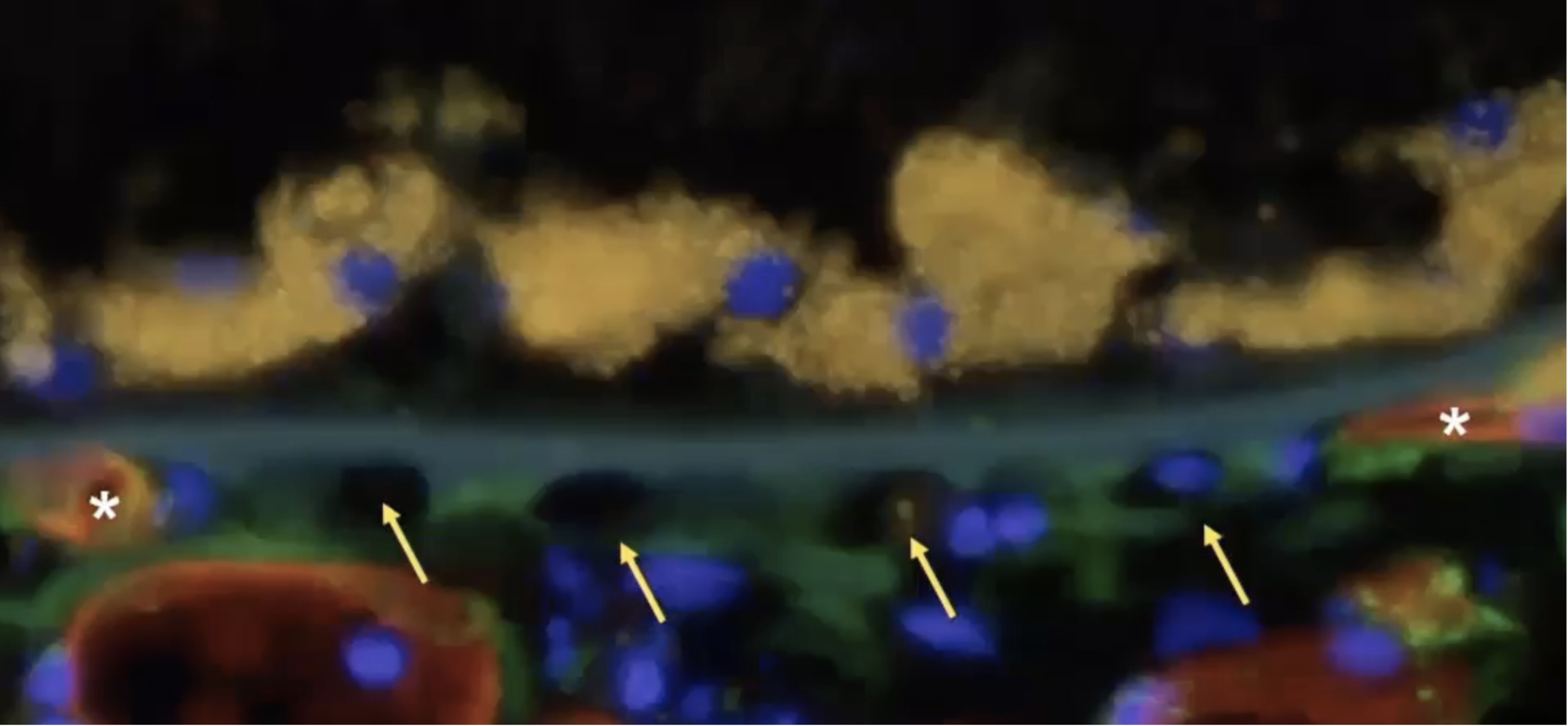
The overactive immune system does not damage the nerve cells and photoreceptors of the retina directly. Instead, it harms the blood vessels that supply the retina with oxygen and nutrients, effectively choking and starving it. The inside of blood vessels is lined by a delicate layer of proteins to ensure smooth blood flow. Patricia D’Amore, PhD, professor at Harvard Medical School, showed that inflammation in AMD breaks down this protective layer, making the blood vessels leaky and reducing blood flow. Dr. Robert Mullins showed microscope images of “ghost vessels,” the empty remnants of blood vessels that no longer carry blood because of tissue damage caused by inflammation.
Live blood vessels have a red lining (marked by asterisk), while the empty ghost vessels do not (arrows). Photo courtesy of Dr. Robert Mullins.
In short, an overactive immune system with excessive inflammation damages blood vessels. This starves the retina of oxygen and nutrients, and eventually leads to nerve cell death. Past infections, illnesses and other stresses shape our immune system and can influence if we develop AMD and how fast the disease progresses. While we cannot change our past, there is a positive angle to this too. Lifestyle choices such as eating a balanced diet (see above) can reduce inflammation and immune overactivation and lower the risk of developing AMD.
Scientists Now Know More About AMD Than Ever Before
Presenters shared several cutting-edge techniques that promise to benefit AMD research. For example, Ruchi Sharma, PhD, senior scientist at the National Eye Institute and BrightFocus Macular Degeneration Research grantee, outlined how retinal cells can now be made in the lab from a person’s skin cells. Using this approach, a patient’s very own genetic risk profile can be studied, opening the door to more individualized treatment options.
AI-based approaches to identify AMD risk genes were presented by Rui Chen, PhD, professor at the University of California, Irvine. Despite a wealth of DNA sequence data, better computational tools and statistical methods are still needed to determine whether a genetic variant is harmless or increases a person’s risk of developing AMD.
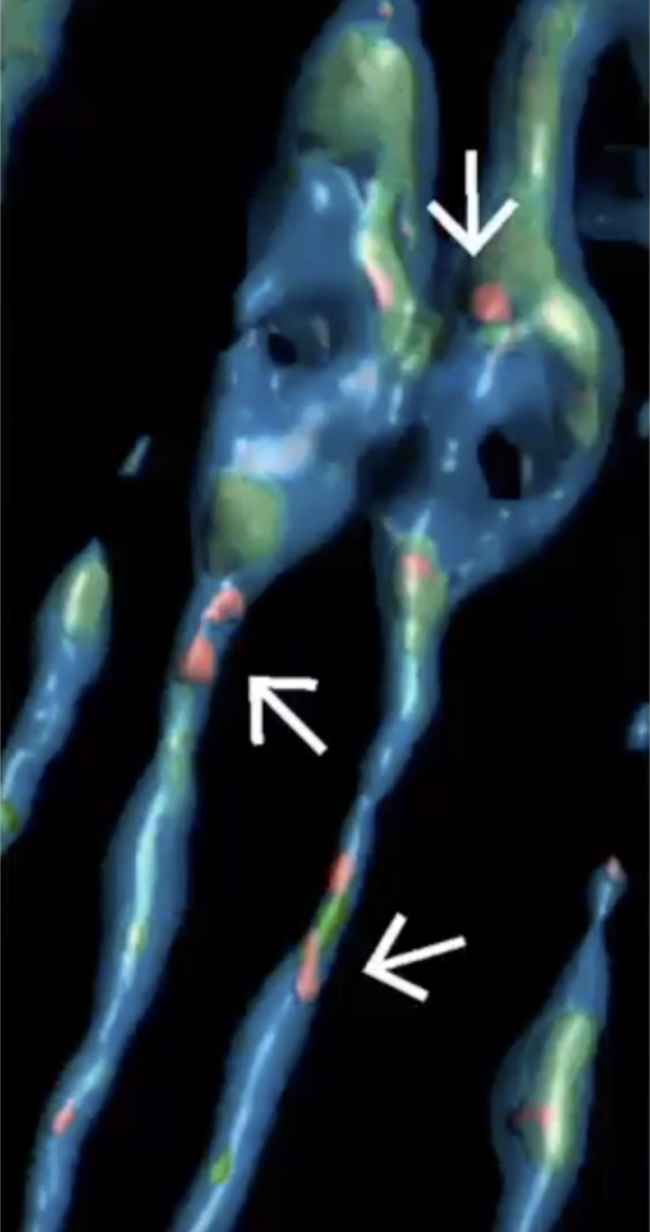
Dr. Patricia Boya’s group has developed a tool to visualize where mitochondria, the cellular energy engines, are being digested. Here you see these as red dots in retinal neurons.
Patricia Boya, PhD, professor at the University of Fribourg in Switzerland, shared fluorescent microscope images that depict how mitochondria, the tiny energy generators in our cells, are broken down in a process called mitophagy. Mitophagy plays a role in the health and survival of neurons, and Dr. Boya’s method allows it to be studied in real-time.
Finally, scientists have made remarkable progress in the prevention and treatment of AMD. As Dr. Keenan explained, the AREDS studies, large clinical trials that gathered data from thousands of people, identified a combination of dietary supplements, including vitamins, minerals and plant-based molecules, that slow the progression of AMD. Known as AREDS2, this formulation is now widely available over-the-counter. When taken by people with intermediate AMD, it reduces the risk of developing advanced AMD by about 25%.
Dr. Chakravarthy described another major success story in the treatment of wet AMD, a fast-progressing form of the disease, where newly formed abnormal, leaky blood vessels damage the retina. Drug treatments that block the growth of these new blood vessels are now widely used and have cut the incidence of legal blindness due to wet AMD roughly in half.
These examples illustrate how AMD research is advancing on many fronts, from basic research to the clinic, uncovering new disease mechanisms, risk factors and treatment approaches. While AMD remains a leading cause of vision loss, innovative research funded by BrightFocus’ Macular Degeneration Research program, is driving meaningful progress and offers real hope for prevention, earlier intervention and better outcomes for people living with AMD.
Diane Bovenkamp, PhD, BrightFocus Foundation: Welcome and Introduction
Patricia Boya, PhD, University of Fribourg (Switzerland): Mitophagy at the Crossroads of Neuroinflammation During Retina Aging and Disease
Matthew Campbell, PhD, Trinity College Dublin (Ireland): The Role of the Inner Blood Retina Barrier in AMD*
Usha Chakravarthy, MD, PhD, Queen’s University of Belfast (UK): From Drusen to Vision Loss: What is AMD?
Rui Chen, PhD, University of California, Irvine (USA): Mapping Causal Genes and Variants in AMD Using a Multi-Omics Approach
Patricia A. D’Amore, PhD, Schepens Eye Institute, Massachusetts Eye and Ear Infirmary (USA): Underappreciated Roles of the Glycocalyx in Endothelial Biology
Tiarnan D. L. Keenan, MD, PhD, National Eye Institute/National Institutes of Health (USA): AMD: A Tale of Two Stages
Robert Mullins, PhD, University of Iowa (USA): The Choroid
Mike (Przemyslaw) Sapieha, PhD, Université de Montréal (Canada): Innate Immune Memory in AMD*
Ruchi Sharma, PhD, National Eye Institute/National Institutes of Health (USA): iPSC-derived Retinal Tissues to Model and Understand AMD Disease Pathogenesis*
*Macular Degeneration Research-funded scientist
Thank you to our sponsors of this year’s AMD Fast Track:
BrightFocus Foundation Board of Directors
RKD Group
J.P. Morgan Private Bank
Atlantic Union Bank
Corentus
Copilevitz, Lam & Raney
Stelter
Moore
About BrightFocus Foundation
BrightFocus Foundation is a premier global nonprofit funder of research to defeat Alzheimer’s, macular degeneration, and glaucoma. Since its inception more than 50 years ago, BrightFocus and its flagship research programs—Alzheimer’s Disease Research, Macular Degeneration Research, and National Glaucoma Research—has awarded more than $300 million in research grants to scientists around the world, catalyzing thousands of scientific breakthroughs, life-enhancing treatments, and diagnostic tools. We also share the latest research findings, expert information, and resources to empower the millions impacted by these devastating diseases. Learn more at brightfocus.org.
Disclaimer: The information provided here is a public service of BrightFocus Foundation and is not intended to constitute medical advice. Please consult your physician for personalized medical, dietary, and/or exercise advice. Any medications or supplements should only be taken under medical supervision. BrightFocus Foundation does not endorse any medical products or therapies.
Share this post
News
Related Articles and Information
Article
How Understanding Lipid Processing in the Eye Could Spark Innovative AMD Treatment Approaches
With the help of funding from Macular Degeneration Research, Dr. Neetu Kushwah is studying the link between abnormal lipid regulation in the eye, inflammation, and age-related macular degeneration. Her findings could inspire new methods for treating the disease.
Article
Early Research Funding Is Essential to Saving Sight From Macular Degeneration
Medicine's biggest breakthroughs often start out as the smallest of ideas. BrightFocus Foundation’s Macular Degeneration Research supports bold, early-stage science across a wide range of approaches.
Article
Macular Degeneration Research News: Fall 2025
In this issue: Light Therapy Is Shining, New Hope on Vision Loss, Can We Turn Back the Clock on Vision Loss? And more!
Article
New Supplement to Prevent Macular Degeneration Inspires Deeper Search for Cures
A Macular Degeneration Research-funded scientist launched a supplement based on a link he discovered between the eye disease and Parkinson’s disease. Now he’s continuing research in the hopes of finding novel cures.
Article
Transforming Macular Degeneration Care With Long-Acting Treatment
With funding from Macular Degeneration Research, Dr. Daisy Shu is exploring advanced drug delivery systems that release medicine slowly over time. This innovative approach could reduce the number of injections needed for macular degeneration while maintaining vision-saving results.
Article
How Targeting a Molecular 'Switch' Could Inspire New Macular Degeneration Treatments
A researcher funded by BrightFocus’ Macular Degeneration Research is zeroing in on a protein that damages eye cells in the early stages of dry age-related macular degeneration, offering insights that could lead to new treatments.